Vigilante Kindness: From the Bottom of My Liver

Sweet Vigilantes, your Vigilante Work Study dollars have been hard at work helping students who want to earn school fees, money for textbooks, etc.  Using work study dollars I bought some of Ivan’s paintings and Ivan was able to pay the balance of his school fees and those of his sister, Lillian, for the term that has just ended.  Now that you’re buying up the rest of his paintings, almost as fast as he can paint them, he and Lillian are in good shape for next term.

Opiyo Chris, the first Work Study scholarship kid, is teaching math classes to primary kids during their upcoming holiday break.  He will earn enough Vigilante Kindness Work Study dollars to pay for everything he needs for his next term, while we wait interminably for his passport to be approved so he can finish his high school career in Medford, OR. where he received a full ride scholarship to a private high school.

And of course there’s Denis.  I used Vigilante Kindness Work Study dollars to pay for textbooks and in return Denis is teaching the women of Te Okot to make paper bead jewelry, which will allow them to make and sell goods and earn money of their own.  I love these business minded women so much.

My son, William, is also one of the recipients of the Work Study Vigilante Kindness dollars, but not in the way you might think.  William works as a biology and computer lab assistant at a high school here.  He is in college and uses the money he earns to pay his tuition, but also to pay the school fees of his younger cousins.  William is such a hard-working kid, but this year he didn’t make quite enough to support his cousins as well, so your Vigilante dollars helped William pass on the gift of education to the next generation of his family.

There’s one last recipient of your Vigilante Kindness Work Study dollars.  And he’s not a student.  Patrick is a father of four and his two youngest children are in high school.  I met his two youngest kids, Emmanuel and Lydia, on my first trip to Uganda when they wrote beautiful pieces for our book.  Patrick is a part-time literature professor and has been struggling to pay their school fees on his shoestring of a salary.  Teacher friends, I know you can relate.  Because he’s an educated man and a teacher, I knew Patrick would be the perfect person to teach me Acoli.  So each day I go to his house for an hour to an hour and a half and he patiently teaches me to speak, write and read Acoli.  In return I pay him so that he can pay for Lydia and Emmanuel to attend school.

There are a few other things you should know about Patrick.  He takes in his nieces and nephews who don’t have anyone to care for them.  One of his nephews is my son, Martin, who Patrick rescued from the streets when Martin was a very young child.  Another interesting fact about Patrick is that his father was a chief, but when his father became a Christian, he renounced his chiefdom because being chief meant preserving practices he no longer agreed with, like witchcraft and polygamy.  So Patrick’s family doesn’t receive any of the benefits of being in the lineage of the chief because they have chosen to live as Christians, even though that means missing out on many privileges.

Needless to say, I’ve learned quite a lot from Patrick, but for our purposes I’ll stick to some things I’ve learned specifically about the Acoli language.  The Acoli language doesn’t have the letters h, q, s,  x or z.  They also have a letter that makes the “ng” sound that looks like an n with a tail.  My keyboard won’t type it.

Learning and conjugating verbs is the toughest thing for me so far.  Pwonyo, one of my favorite verbs, means to teach.  Leko means to dream.  Ngwech means to ride a bicycle.  And perhaps the hardest one of all for me, both to say and learn to do, is ling mot, meaning to be quiet and still.

In addition to learning verbs and the alphabet, I can now name body parts.  The funniest one I’ve learned so far is “dog” meaning mouth.  My mouth often gets me in trouble so I like the idea of being able to call it bad dog.  Dog arach means “My mouth is bad.”  It figures that would be one of the first sentences I’d learn.

Perhaps the greatest thing I’ve learned is that when the Acoli people speak of their feelings, they don’t speak of the heart, they speak of the liver.

Sweet Vigilantes of Kindness, it’s because of you that Ivan, Lillian, Opiyo Chris, Denis, Lydia, Emmanuel, and William’s young cousins get the privilege of being educated.

It’s with all sincerity and profound gratitude that I say to you, “Amari i wi cwinya.”  I love you from the bottom of my liver.
 

Vigilante Kindness: A New Lens

I take a last sip of steaming hot tea before meeting up with Richard, one of my sweet boys, on this blessedly cool morning.  He arrives dressed in his school uniform, complete with necktie, and we walk the streets of Gulu, already flush with sound and color. We’re walking to the hospital.

“Let me see your socks,” I say.  Richard is taller than I am now, but still thin as a rail.

“You remember that?  You can’t forget anything,” he grins, the gap between his two front teeth making him still look like a kid.

“Of course I remember.” We’re both quiet, remembering the day last year when he got dressed in the dark and accidentally put on mismatched socks, the day when we went to the hospital for his HIV test, which to our delight and surprise was negative.  “Now show me your socks.”

“My socks are not there today,” he lifts the cuff of his pant leg and shows his bare ankle above his shoe.

Today we’re going to a different hospital to get glasses for Richard so that he can read again.

“Excuse me, can you help me cross the road?  I can’t see well,”  another teenage boy walking in front of us turns around and asks.

When he turns I see that his right eye is white with cataracts.  Richard introduces himself to this boy and tells him that we’re going to the same place.

“I’m Alicia,” I say, shaking his hand.

“I’m Kennet,” he greets me in return.

Richard grabs Kennet’s left hand and I grab his right hand.  We turn to the road.  It’s wide and teeming with cars, boda bodas, bicycles and people on foot.  It’s tough even for perfectly sighted people to navigate.

We cross halfway and stop, letting more cars and boda bodas pass.

“Wait,” I tell Kennet as a last car zips past.  “Ok, now we can go.”

We cross the street easily and Kennet drops my hand.  He keeps hold of Richard’s hand and I slip in behind them, tucking in away from the traffic, listening to their conversation.  Richard guides Kennet beautifully, asking questions about where he goes to school and questioning him about the future of his eye. They hold hands every step.

We cross one more street to the small gated entrance to the part of the hospital that specializes in optic care.  Kennet branches off to the door of his department.  Richard and I sit on benches near the clinic where we wait to get glasses.

We wait.  And then wait some more.  Last year we waited for hours and hours on end at the hospital.  Waiting for HIV test results felt like two eternities, so waiting for glasses is nothing.

“I’m one of the lucky ones,” Richard tells me.

“Why?”

“Ten of us came and seven needed surgery.  I’m one of the lucky ones because I only need glasses.”

We’re both quiet.  I think of Kennet.  Lucky indeed.

An hour and half later the nurse arrives.  She’s a wide woman with a kind temperament.  Her name is Ida and I like her immediately.  She apologizes for being delayed and explains that her husband got a last-minute job driving a group of people on safari and she had to help him prepare.

“It’s ok.  That’s a well-paying job, not one he can pass up,” I smile and she is visibly relieved.

“It’s not easy to make money here,” Ida explains.

“I know,” I don’t know how to reassure her beyond that and I don’t want to cross the line into pity, so I change the subject.  “What do we need to do today to get this kid glasses?”  I motion at Richard, who has taken a seat on a rolling stool opposite me.

“The glasses need to be paid for and I need to make sure his vision hasn’t changes and then measure the space between his eyes for a good fit,”

“That’s all?”

“Yes.” Ida rolls Richard over to the eye machine.  He rests his chin in the machine and tries unsuccessfully not to blink.

We’re done in five minutes and I hand Ida a thick wad of Vigilante shillings.  In return she tells me where to pick up the glasses the following day.

The following afternoon I deliver the glasses to Richard at school.  He’s outside having P.E., a basketball lesson with special coaches from town.  I pull the large, sealed envelope containing the glasses out of my backpack and hand it to him.  He puts the glasses on immediately and I take a snap with my camera.

It’s a clear day, not a cloud in the sky, the perfect day for perfect vision.

Watching him try out his new glasses, I can’t help but think of the pastor’s message a couple of Sundays ago at church.  He said that we all have a choice, to look at life through the lens of fear or through the lens of faith.

If you’ve spent more than a minute with me, you know fear is not on my radar.  Frankly, I could use a healthy dose of fear now and then.

But faith is also not on my radar.

Now hold on before you go thinking I’ve denounced Christ or something dramatic like that.  I’m not talking about my faith as in the doctrine of what I believe.  That’s a well dug deep into the core of who I am.

I’m talking about having faith.  I want to tread carefully here and not start speaking Christian-ease because I hatehatehate it when people can’t talk about having faith without throwing in pious buzzwords.

What I’m saying is this: I struggle with believing in things to come that I can’t yet see.  I’ve said before that I’m the kind of girl who has to stick my fingers in the nail holes to believe.  I’m not proud of that, but I’m on-my-face grateful that God knows that about me and extends His nail holed hands to me anyway.

If you’ve been following along in my Vigilante Kindness adventures, then you know a well to provide clean drinking water for the small village of Te Okot is in the works.  What you don’t know is that the well team has been delayed and are still finishing a well in another part of the country and that the funds donated to begin the well have not yet reached me.

My mom, who was here with me and who seems to have an infinite amount of assured faith, kept telling me not to worry, that it will be accomplished in God’s perfect time, that I should have faith.

All of those things are true.

And yet, I can’t rest easy until I see that water, until the people of Te Okot are drinking water not infested with diseases and elephant fecal matter.

I want to touch the water, to pump it into a bucket and see it run clear.

I’m losing hope of being able to see the water for myself.  I’m here for a scant twelve more days and not an inch of the well has been dug.

Not an inch.  Not yet.

I’m clinging fiercely to that ‘not yet’.  It’s all the faith I can muster and thank God, thank God, thank God a smidge is enough.

I’m trying so badly to see this well project through the lens of faith.  I’m choosing to believe it’s going to happen.  And I mean the kind of choosing where Having Faith and Not Having Faith are on equal footing and I’m grabbing hold of Having Faith and running away from Not Having Faith, which is perpetually gaining ground on me.

Dear ones, I imagine you know that kind of desperation, to cling to faith with trembling fingers because holding on and running like hell away from doubt is sometimes all you can do.

Me, too.

God is in those times with you.  And with me.  Is anyone else overcome with relief?

At night I wake thinking of Richard and his new glasses and I pray for God to help me see life with more faith.

I think of Kennet, who will have his cataracts removed soon, and I pray for two things: for God to remove my lack of faith and also that I’d be boldly humble like Kennet in admitting when I need God to hold my hand along the way.

I think of the people of Te Okot who are strong and sure in their faith that clean water is coming.  I think of all of you: family, friends and complete strangers who doled out your faith in lumps of cold, hard cash believing right along with the people of Te Okot that safe, clean water is on the way.  I say a prayer of thanks that when my faith is present in the most meager amounts, your faith in God, your faith in this work I get to do remains steady.  In my dreams I cling with trembling fingers to that, to all of you, and when the sun shines through my curtain in the morning, I wake grateful for another opportunity to see things with a little more faith than I did the day before.

Vigilante Kindness: A New Dress

We walk through the dark streets of Gulu, letting the sounds of town fill in the silent spaces of our conversation.  There aren’t many spaces to be filled and the lack of electricity means there are also fewer sounds of the town, only the hum of a handful of generators and throbbing dance music coming from a club a few streets away.

Our stomachs are full of pork and cassava from my mom’s going away dinner at a local pork joint called Alulululu.  My mom called it Alulululululululululululululu and everyone at the table giggled because, as she said several times, all of her syllables are in the wrong places.   There were six of us at dinner and in order to be heard over the din of the rain on the tin roof, we shouted most of the night.

Everyone else peeled off after dinner, riding bikes or bodas back home.  This, this distilled quiet time, walking back to the hotel with Ivan is precious.

We recount the dinner conversations and pretend to speed skate home through the streets of town.  In our minds we’re fantastic speedskaters.  Power is scarce, so light is also scarce and nobody can see well enough to laugh at us.   Ivan rarely gets to be a kid, so fake speedskating through town, laughing until our cheeks hurt and doing other goofy things is a necessary component in each piece of our time together.

He paints, well and constantly, to ensure that he and his sister get to go to school.  He pays the rent for his studio and collects the rent from other artists sharing his space.  Most nights he sleeps in the studio because he can’t afford the boda boda fare from his house to the studio.  He keeps a rolled up mattress under the table and pulls it out each night to sleep amongst his paintings.

As we walk, he tells me the story of painting at the TAKS (Through Art Keep Smiling) Center.  His face is all lit up as he fills in the details of getting to paint in public and getting to talk about what painting means to him.  He painted a LOVE Africa piece and at the end of his time, he was offered a position helping teach Art Therapy.

He’s over the moon and I’m somewhere beyond that because he deserves to be a successful, working artist.  He deserves to make a living.  He deserves to have a bed, not a rolled up mattress under a table.  He deserves an education.  He deserves not to worry about his sister.

“I bought my sister a new dress with some of the money I got from the paintings you sold,” he smiles, his big toothy grin brilliantly visible in the inky night.

“From the fashion store you were telling me about?”

“Yes.  Do you know why I bought her a dress?”

“Um, because you love her?”  It’s obvious in everything Ivan does just how much he loves his sister.

“Because I love her and I want her to know she’s special.  Just because we don’t have parents, I still want her to feel cared for.  I don’t want her to think she has to go looking for that from guys and then get into trouble.”

Just when I think I can’t love this kid another drop more, he goes and buys a new dress for his sister and my heart shifts into overflow mode.

“You’re a great big brother, you know that?”

“Thanks,” he swallows hard.  Compliments are difficult for him to accept and I make a note to speak them more often.

Ivan’s learning to skateboard and as our conversation ebbs and flows we fake skateboard down the last street.  We practice all of our best fake tricks and in our minds we’re fantastic.

Vigilante Kindness: Te Okot, Part 3

If you’re just joining the story of Te Okot, read Part 1 here and Part 2 here.

I swore to myself I’d never ride a boda boda out to Te Okot or anywhere else that far away again.

And yet yesterday morning I found myself on the back of Bitek’s sport bike.  The knobby tires made quick work of the slick mud that is half of the road to Te Okot.  All hope I had of arriving to the village in any sort of tidy condition was quickly taken care of by the skunk stripe of mud up my back and the mud splattering my face.  The road was so rough that every tooth nearly rattled out of my head.  My shoes were slick with mud and my feet were full of pins and needles from sitting in the same position for such a long time.  My feet kept slipping from the foot pegs, so that I burned a nice commemorative quarter-sized exhaust pipe tattoo above my right ankle. And we’ll just not even go into the condition of my hind quarters, which are still not speaking to me for the atrocities I committed against them by taking a boda out to Te Okot and back, not once, but twice in a single week.

Mud stripes, exhaust pipe burns, rattled teeth and a tush that will probably be on permanent strike-all of those minor inconveniences pale, pale, pale in comparison to hardship of living without drinkable water.  And for me, those minor pains couldn’t hold a candle to the hope I held that when Bitek surveyed the land, he’d find a viable place to drill for water.

Water.  Beautiful, clean, healthy water.

We reached Bungatira and I laughed when Denis greeted me by shouting,

“Acureque!”  (I have no idea how to spell that word.) In Acholi, it means something like, “You’ve kept me waiting!”

It’s our joke because each time Denis would pick me up, I’d put my hands on my hips, furrow my brow and shout, “Acureque!”  Then as we pulled away, we’d break into peals of laughter at the shocked faces of the surrounding Acholis who were stunned to hear a Muzungu shouting in Acholi.

So when Denis shouted it at me, I broke into a wide grin and hopped off Bitek’s bike, almost falling on my face because my feet, legs and rear had all conspired revenge upon me.  I regained my balance and hugged Denis hard, trying not to wince at how thin he’s grown, trying not to think of how little food he and his family have had access to lately.

After introductions, Denis led us inside his hut, which he’d worked hard to expand this week just so we could come inside and have a place to sit.

We sat inside drinking lukewarm bottled soda that Denis had purchased for just this occasion. Men and women and children entered the hut and greeted us, some staying and sitting with us, others shaking hands and returning to the hard work of life.

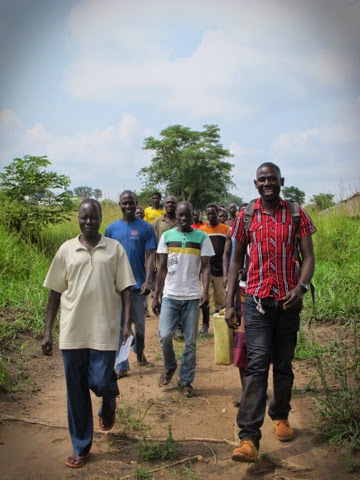
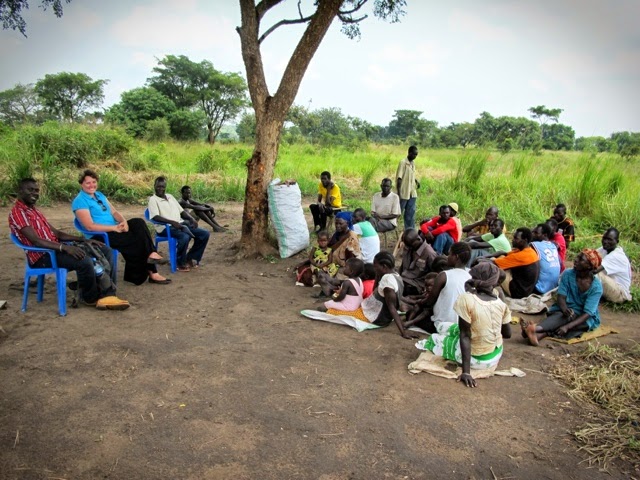
After a sufficient amount of rest in the hut, we tromped through the compound and through the bush to the water source.  Everyone followed us, except some of the women who were tending to the littlest children and the people who were too old to make the trek.  Men, women, children all trailed the Musee, Bitek and I.  We were quite the parade of people.

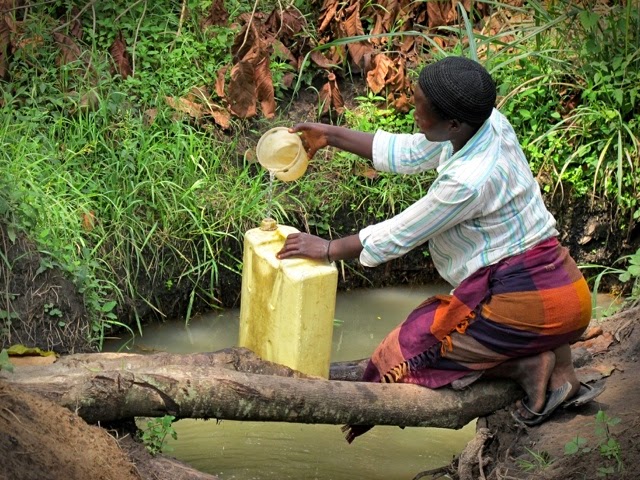
Bitek and I snapped photos, he for documentation of the project and me for the joy of it, for the sheer delight I took in this community expedition in search of the best place to mine water.  Bitek stopped several times examining the rocks and dirt, fingering the soil for moisture content, peering into the roasting pit at the stratospheric layers of the ground.We spent quite a bit of time at the current water source and snapped a handful of photos of Agnes filling her jerrican full of the dank water.

I shuddered thinking of sweet Aber drinking that water and felt a pang of sadness stab at my heart because just minutes earlier as we’d walked down the path, Agnes had leaned into me and whispered, “If you can’t take Olarra, take Aber.”  The desperation in her voice to give her children a chance at a healthier, educated life gripped me and I blinked back tears and told her I can’t take her children.

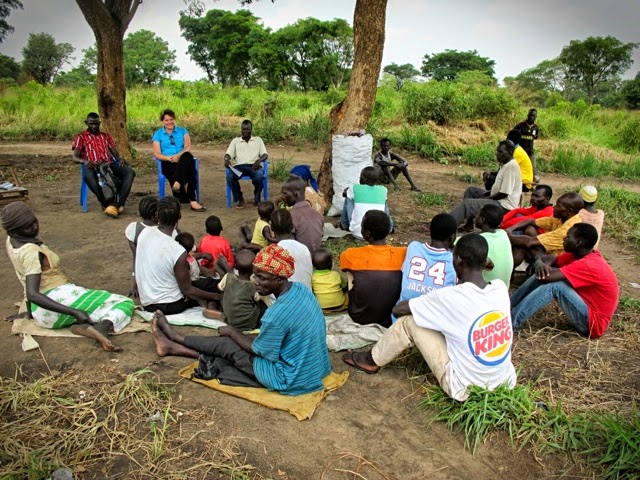
After Bitek surveyed the water hole we marched back up the hill. Bitek took several small side excursions off of the trail to examine all of the possibilities and then to cross some of them off because they were in the direct path of the elephants, who had trampled the tall grasses so flatly that it looked like large trucks had motored through.We paused under a large tree and Bitek declared that this would be the first drilling site.  If the well construction team reachedundrillable rock, they’d move further down the hill and drill at a second site.We finished tromping up the hill to where the rest of the community had gathered on mats in the shade of a large tree.  There were four chairs set in the front: one for Musee, one for me, one for Bitek and one for Denis.  As I went to sit in the chair beside Musee, Bitek pointed to the mats, “Women sit on the ground.”  He was half joking and half informing me of the culture.  I replied that I’d sit wherever the Musee asked me to.  Musee was quick to respond to Bitek, “Alicia sits in the chair beside me.”


Denis spoke briefly, followed by the Musee.  Then it was my turn to speak.  I told the group how I’d done what I’d promised, I’d written their story and indeed people had responded.  I told them about how my little brother was spearheading money collection at home and they broke into applause and asked me to pass along their joyful thanks.  I told them how I’d placed a call to Bitek, the only person I know who knows how to build wells.Then I turned it over to Bitek who told them all the details of their coming well.  He told them about the well site and why he’d chosen it and about how the construction team trains the community members to repair and upkeep the well.  He told them about their responsibility to feed and house the construction team while the well was being built.  They had many questions and he answered each one with care.When would construction begin?

In one week after the construction team finishes building a well in the town of Sorotti.

How long would it take?

Two weeks.

How many community members would they train to keep the well in working order?

As many as want to be trained.

Would they leave them the appropriate tools to maintain the well?

Repair of well only requires the use of one wrench.  I nodded emphatically when Bitek asked if I was including the purchase of the wrench with the well.

Would there be a possibility for the men they train to go out and build wells for them?

Yes, they take workers from each past well construction site to build wells at the new sites.

If there’s any money left over from the building of the well, could it go into their community microloan treasury?

My heart did a happy flip-flop at that and I answered, “Yes, definitely yes.”

When the questions had all been answered, we moved on to discussing the solar lights. One of the community members thanked me for the lights because he no longer has to buy and burn paraffin in his hut.  Denis told me that for the past two nights the wild elephants had come through the compound and when the people put their lights out, the elephants moved away.  Another member timidly asked if there were any lights still left because some of them had been sowing seeds for crops during the last meeting and didn’t receive a light.  Again I answered, definitely yes.

As the meeting drew to a close, one of the members spoke to Bitek in Acholi.  Bitek laughed and turned to me, “You’re building them a medical clinic next?”

“No, I don’t know anything about building a medical clinics, Bitek.”

Patrick, one of teenagers of Te Okot, spoke up, “Yes, Alicia, but you don’t know anything about building wells either.”  He smiled at me with a glint of mischief in his eyes.

“Good point, Patrick.”

Then it was time to say goodbye and get back on the dreaded boda boda.  My lower half protested as soon as I sat down.  After an hour on the motorcycle, Bitek and I stopped for a late lunch in the town of Annaka.  He ate goat.  I had beans and potatoes.

We talked about the other wells Bitek has built and then the conversation turned back to Te Okot.  “It’s going to be hard for them to get enough food to feed us.  Maybe you could buy the food and their contribution could be preparing it for us?”  Bitek suggested between bites of goat.

“Of course.  Just tell me what and how much to buy and where to buy it.”

After lunch, I told Bitek that I simply could not, could not, could not get back on the boda.  I was in too much pain so I would either walk the 52 kilometers back to Gulu, find a car to take me or, if necessary, take up residence in Annaka.

To my delight, Bitek found a taxi taking four other well-dressed women to Gulu.  It was leaving right then and for 10,000 shillings (roughly $4) I bought a seat in the taxi, a banged up Honda Accord.  Dear ones, let me tell you that may be the best four bucks I’ve ever spent.

Bitek insisted on following the taxi back to Gulu to make sure I made it there safely.  As I drifted in and out of sleep to the sound of the happy chatter of the women in the car with me, my rear end gave thanks for small things like taxis to Gulu and my heart gave thanks for larger things like glorious, clean water.

Got Apwoyo?

I set a meeting with Bitek, my Acholi friend who digs wells, for nine in the morning.  So at ten o’clock Bitek arrives.

We sit out on the patio in front of the hotel, sipping hot tea.  He tells me a little about his trip from Sorotti.  It took him all of last night and all of the morning to reach here.  We talk a bit about his younger brother, whom we both adore, and then I show him the photos of the water source of Te Okot.

“They’re drinking this, Bitek.”

“It’s no good,” he agrees.

“What would it take to get them a well?”  I brace myself to hear the improbable, if not the impossible.  My thread of faith is thin, but it’s a thread nonetheless and I can’t sleep at night knowing that a lack of clean water is killing the people of Te Okot.

“I’d need to go out and survey the land first, but once we found a water source, then we’d start drilling.”

“How long would that take?  And how much would it cost?”  I gulp hot tea too quickly and it steams down my throat.

“It takes two weeks and costs one thousand five hundred dollars.”

“What???  One thousand five hundred dollars?”

Relief floods my face and I feel flushed with the possibility of clean, drinkable water. For Denis and his family.  For Mama & Musee.  For Michael and Onen and Patrick and their wives and children.  For Agnes and Olarra and sweet, baby Aber.

Water.

The word overwhelms me, becomes the thump of my heart hidden deep inside my chest.

Wa-ter, wa-ter, wa-ter.

I think of the people of Te Okot and how when I asked them to prioritize among a school, a medical clinic and water, they shouted, “Pii!  Pii!  Pii!”  Water!  Water!  Water!

Bitek continues.  “The community is responsible for feeding the workers while we are there.  Then we train 2-3 men on how to maintain the well so that when parts need replacement, they can do it themselves instead of relying on us.”

I love this plan so much that I narrowly resist the urge to tackle Bitek, to drown him in gangly hugs that are far too tight and far too long.

“What’s your schedule like?  I mean, when could you start?”  I can barely remain in my seat.

“We could go survey the site tomorrow and then we just have to finish the well in Sorotti.  After that we have no wells to dig.  Our timeline is empty.”

“Really???”  It comes out as a squeal.

I place a quick call to Denis to make sure tomorrow is okay.  He confirms that it is and thanks me more times than I can count.

Bitek asks about my mom and I take the stairs two at a time until I reach her door.  I’m breathless and don’t even wait for her to open the door.  I shout the good news about the possibility of water through her door.

The word pulses through my veins now.

Waterwaterwwaterwaterwaterwwaterwaterwater.

After a few minutes of visiting with my mom, Bitek leaves us with the promise to pick me up at eight the next morning.  I’ll be ready at eight.  He will likely arrive at nine and then we’ll ride his boda boda three hours to Te Okot to survey the land, to look for signs of water hidden deep within the heart of the land.

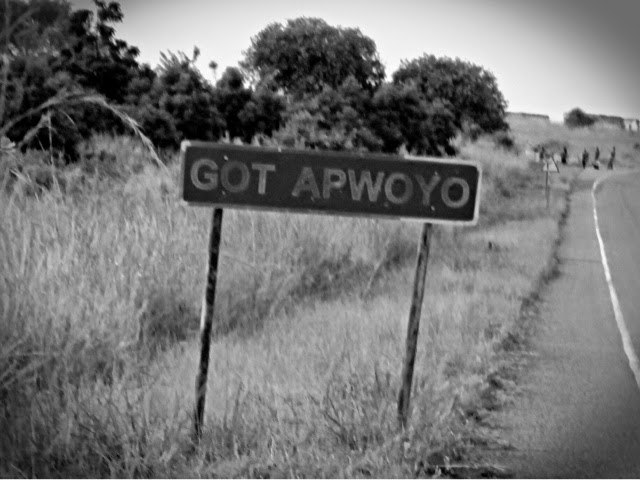
There’s a road sign on the way to Te Okot that says Got Apwoyo.  The literal translation of Apwoyo is ‘rabbit’, but it’s also the word for ‘hello’ and most importantly it’s the word for ‘thanks’.  Got means ‘mountain’.  So while the sign is really a marker for Mt. Rabbit, I can’t help but think that the sign is asking me, “Got thanks?”

Power has gone out again and in the darkening night I pray for the heart of the land of Te Okot to run deep with water.  And then I think of that road sign and pray that my heart will run deep with gratitude.  Got Apwoyo, indeed.