We’re a rag-tag group of people vigilantly pursuing self-sustaining educational & employment opportunities with and for students and their families living in rural communities in developing countries. We believe in asking hard questions like, “What do you need and how can we help?” We believe that communities know their needs better than we do and that it’s our job to listen. We’re big on being kind for the sake of kindness and we believe that even the smallest acts of kindness can make a big difference. We believe in keeping vigil over one another and watching for opportunities to help, no matter how far off the beaten path those opportunities take us. We’re vigilant in our belief that God has given each person unique gifts and that one of the highest forms of worship is using those gifts to serve others. We believe God has a purpose for each life and Vigilante Kindness is our purpose. Join us as we live out wild adventures in service of God and others. Join us in committing acts of Vigilante Kindness.
My tiny hotel room smelled like bananas. The two clusters of bananas I’d bought were fresh from the tree and their smell permeated my living space.
The morning of Visitation Day at the school had arrived. Parents would arrive to visit their children and to talk with the teachers about their child’s progress. For most it would be a happy day.
For the orphaned students it would be one of the most difficult days of the year.
The school had been buzzing about Visitation Day for weeks, but underneath the excitement I heard quieter voices, one in particular belonging to Ivy.
“Ivy, are you excited for Visitation Day?” I asked.
“Sure,” she shrugged the word out of her mouth.
“Is your family coming to visit you?”
“No, my parents died when I was a baby and my aunt is paralyzed and lives too far away to travel.”
“I’m coming to Visitation Day to visit my sons. Maybe I could visit you, too?” I suggested.
“I’d like that,” she smiled and looked down. “Alicia, lots of kids here call you Mum. I know you have three sons. Could I call myself your daughter?” Ivy avoided eye contact.
I was taken aback by her request, but when I saw her downcast face, the only appropriate response was, “I’d like that, Ivy.”
“Good. Then when the other kids ask who is coming to visit me on VD, I can say my Mum is coming to visit,” she smiled at me from behind her glasses.
I picked my heart up off the ground and wondered how many other orphaned kids were wanting to, but couldn’t say their mom was coming to visit.
Word spread around the school that I’d be visiting kids that day and soon the list of kids claiming me as their visitor grew quite long. I asked around about exactly what it is parents do on Visitation Day. In addition to visiting their children, and speaking with the teachers, parents bring them special foods from home.
I had the visiting thing under control, but I didn’t have the skills or the kitchen to prepare any special foods from home. So I called in help. The day before Visitation Day, I had a meeting with Joseph, the fledgling chef who works at the hotel where I’m staying. Joseph is twenty-one years old and is trying desperately to earn enough money to finish his final year of culinary school.
“Joseph, tomorrow is Visitation Day at my school and I’m going to have a big picnic. Where could I get a ton of chipatti and a fresh order of bananas, too?” I sat across the table from him, drinking mango juice he’d squeezed that morning.
“Give me the contract and I’ll have everything perfect for you tomorrow morning,” Joseph replied.
We agreed on an amount and I gave him some Vigilante shillings. We shook hands and the evening before Visitation Day, two clusters of fresh bananas were placed in my room and the morning of Visitation Day, the chipatti was perfect, just as Joseph promised. I already had a jar of fresh groundnut paste (like peanut butter, only better) that would round out the meal.
I’d planned on looking my best for Visitation Day, wearing my cleanest hand-washed clothes, shaving the layers of dirt off my legs and washing my hair, no matter how frigid the water was. I woke up that morning and didn’t hear the familiar rumbling sound of the back up generator. Oh, good, there’s electricity today. I flipped the light switch. Nothing happened. Oh well, no electricity today. In the bathroom I turned the hot and cold water knobs. Again nothing happened. I guess I don’t have to worry about cold water or any water for that matter. I put my relatively clean clothes on my relatively dirty body, brushed my teeth with my one remaining bottle of water and clamped a headband on top of my out of control curls. I looked in the mirror. It would have to do for the day.
It rained the entire morning and I sat by the window in my room willing the rain to stop. Instead it poured harder. The streets were devoid of sputtering bodas. When the rain slowed to a drizzle, I packed the bananas, chipatti and groundnut paste into my backpack and called my faithful boda driver, Denis. Juba Road was a slick mess of red mud. Mud flicked off the back wheel and splattered my skirt, but I was sure a little water would take care of the mud splatters. That thought was still hanging in the air like a bubble over my head when a truck came barreling down the road from the opposite direction. It raced through a puddle and splashed muddy water all over Denis and I. I was soaked to the bone and at that point all I could do was laugh at the muddy mess I had become.
The drizzle continued all the way to the school and kept parents at bay. The school was quiet and subdued, the gray skies matching the mood. The parents would have to come on foot or by bicycle, so rain was a legitimate, but still disappointing reason for their absence.
When I arrived at school, I pumped water to wash my face and skirt, but the mud was so caked to my skirt that adding water became a recipe for an even bigger mess. So I planted my mud caked self under the covering of the open classroom and waited to visit with students. A few scuttled here and there in the rain, bundled up in layers of jackets in the 70 degree weather. As the students hurried by, I called out, “Happy visitation day! Come and visit with me!” Almost every student I invited took me up on my offer and pretty soon I had a cluster of kids around me, some who were on my list to visit and other new additions. My two youngest sons were at the center of it all and they were in fine form hamming it up.
One of my favorite boys, a sweet orphaned boy, said, “I didn’t think you would come because of the rain.”
“I promised you I’d come. It’s my first Visitation Day. I’d planned to look a little more presentable, but that didn’t work out so well for me.” We both laughed at my mud stained clothes.
“It’s okay, Mum. I’m glad you showed up.”
We were having a great time and before we knew it, it was lunch time and so we retreated into a classroom where anyone and everyone was welcome to the feast I’d carried in my backpack. When I unpacked it, one of the boys remarked, “You brought us food just like the mothers do on VD!” They devoured the food like a band of locusts. I must admit my eyes welled up when every single child made sure to thank me afterward.
While we were inside eating, the rain stopped, the clouds parted and the sun came out. Mothers and fathers began to arrive. The mothers were dressed in beautiful clothes and carried baskets of handmade and homegrown food. Not a single one had a splatter of mud on their skirt. They were a parade of beauty and poise and I was a stark contrast.
I continued visiting with students all day, making sure to carve out special one on one time for my sons. It was a beautiful day.
As evening approached, or as they say here, as the sun married the moon, I returned to my hotel where I washed the slicks of mud off my skirt and scrubbed my skin clean with mercifully hot water. Under the tent of my mosquito net, I thought about how it didn’t matter at all that I arrived wet and muddy. What mattered was that I showed up.
Though I searched and searched for her, I never did see Ivy that day. She later told me that she was feeling ill and had slept all day in the dorm. I wonder if the words felt as untrue in her mouth as they sounded in my ears. Many of the orphans feign illness and sleep the day away until it passes. When I told Ivy that I’d missed visiting her, she peered up at me through her glasses and said quietly, “You came for me?” I nodded and she said, “I didn’t think you would. Thanks, Mum.”
The new school year is fast approaching and I know I’m going to have students who are used to being let down by parents who don’t show up. On mornings when I feel caked in frustration with administration, when I feel like I’ve been splattered with parent complaints, when I feel soaked to the bone with exhaustion, I’m going to remember Visitation Day and I’m going to show up. I’m going to show up and have faith that the clouds will part and make way for something beautiful. I’m going to show up and show up and show up, especially for my kids who are hiding out and tucking their hearts safely away. I’m going to show up hoping that when I do, it will give them the courage to do the same.
A friend once advised me that when I find myself in opposition with another, I should “walk into the conflict”, meaning move in closer so that resolution or at least common ground can be found.
It’s a difficult task for me because, well because I’m a giant chicken and my natural inclination is to retreat. It’s even more difficult for me walk into the conflict when I don’t see it coming and then suddenly find myself face to face with it.
Sunday was one of those days.
Bungatira, a village outside of Gulu, is home to Denis, his family and some mighty cute piglets. I was delighted to be invited back along with my son William, and my two new Swedish teacher friends, Annika and Jessica. It was a beautiful day and with a view of the lush green valley that seems to stretch for miles, the ride there didn’t disappoint.
When we arrived in Bungatira we were greeted with a welcome song and dance from Denis’ mother and the ladies of the community. It was lovely.
Bungatira has a local community group, of which Denis is the chairperson. The group is working together to make their community a better place. They’re doing it independently of NGO’s that seem to have set up camp on every corner in Uganda. They’re doing it without government aid. It’s a grass-roots group focused on improving their future.
This group is doing so many great things and I love that all of their ideas are purposes are from within. They’re beginning a savings and loan program for members. They’re looking for ways to fundraise to pay school fees for their children. They’re seeking education on issues like health and cleanliness and domestic violence. They have an eleven article constitution that details the rights and duties of membership. They have democratic elections each year. Membership is open to both male and female residents who are at least twelve years of age. The group in Bungatira is doing so many progressive things, especially when compared with surrounding villages. So when Denis asked if I’d sit in on their meeting and offer them advice if I had any, I was honored. In the back of my mind, I hoped to find another place to exercise some Vigilante Kindness.
After taking a tour of their village and having lunch in Denis’ thatch roof house, Annika, Jessica, William and I joined the meeting in progress outside. I sat down on a mat next to Denis’ mother. The group was discussing the savings and loan idea. I listened in and strained to translate Acholi into English. William joined the meeting as well and sat a few yards away from me, translating when I requested clarification. Annika was feeling ill and so Denis took Jessica and Annika back to their hotel on his boda. The meeting continued in his absence and moved on to elections. Denis was nominated for re-election and I was pleased to see that the nominations for other offices were split between men and women.
The Vice-Chairperson turned his attention to me and asked that I speak well of their group when I returned home. I asked to first read their constitution, which was written in English. The constitution was meticulously written in ink on lined paper, something that is quite costly and not easy to find.
They’d obviously put a lot of thought into it and I agreed with all of it-except their policy for dismissal from the group. Reasons for dismissal from the group were:
voluntarily leaving the group
death
failure to pay membership dues without reasonable cause
mental illness
Wait, what? Mental illness was an automatic reason for dismissal?
I felt like I was having one of those moments in the movies when the people are happy and there’s upbeat music playing and then everything halts as the music comes to an abrupt needle-scratching-across-the-record-stop.
After I read the Constitution, the Vice-Chairperson asked if I’d speak well of their group and be a bridge to anyone in the U.S. who might be able to offer help.
“Your group is doing so many things well, but I’m afraid I’m not the right person to speak on your behalf because I don’t agree with all of the articles in your Constitution.”
“We’re not asking you to support our group financially, just to be a bridge to anyone in the U.S. who might be able to help us. Perhaps you have friends who might be interested in helping,
“I’m sorry, but I cannot speak for your group when I disagree with parts of your Constitution and I don’t want to give you false hope and tell you I’ll be speaking on your behalf when I know in my spirit, I won’t be. I know my friends at home would also disagree with parts of your Constitution.”
“Which parts do you disagree with?”
“I disagree with the two places it says members will be dismissed because they have a mental illness. Maybe I’m not understanding what you mean by mental illness. Perhaps you can explain more.” Walk into the conflict, I reminded myself. I hoped that this was going to be an easily fixable thing that was simply lost in translation.
“It means depression, post-traumatic stress, schizophrenia and other mental illnesses.”
I felt like someone had punched me in the stomach. In the expansive outdoors, suddenly there wasn’t enough air. William moved from his chair and sat down next to me on the mat and I was grateful for his presence in the sea of strangers.
“I’m sorry, but I cannot agree with you. You’re treating those conditions as if the person can choose to have them or choose not to have them. To me it’s like saying a person will be dismissed from your group for contracting malaria.” I thought of my family and friends who have fiercely battled mental illnesses and I felt a lump knot in my throat. I willed myself not to cry. In the bravest voice I could muster I said, “I’m sorry, I simply can’t advocate for a group that discriminates against people with mental illnesses.”
There was a pregnant silence.
Denis’ mother spoke.
“William, what did she say?” I whispered.
“She said that maybe you’d like to see the children sing and dance.”
“Um, sure,” I recognized that retreat tactic and I almost took the welcome escape. Instead I took a deep breath and said, “But I’m not sure how that’s going to help us reach a resolution. Seeing the children sing and dance isn’t going to change my mind on this issue. Perhaps I can see them dance later.”
Another silence followed.
“Lanyero,” the Vice-Chairperson addressed me by my Acholi name. “I’m sorry, but I must go. The discussion will resume when the Chairperson returns. I wish you friendship and a safe journey back home.”
“Apwoyo. Wot maber.” (Thank you and safe journey.) I replied as he and another member climbed on their boda and sped away.
I wished I could have sped away as well, but I was in the middle of the bush, miles away from where I could catch a boda back to town. And so I sat on the mat and willed my tired brain to listen as the group addressed other issues.
I heard Denis’ boda approach from the road behind. He parked his motorcycle and hurried back to the group. After reassuring me that Annika was okay, he turned to the group, which all at once began speaking to him, their thirty some odd voices becoming a complete mash of words to my untrained ears.
“William, what are they saying?” I whispered.
“They’re filling Denis in on everything that was discussed while he was gone.” William leaned in and translated.
After the group spoke, Denis turned to William. “Would you like to say something?”
“I have already spoken,” William replied. It was true that William had spoken freely throughout the meeting, voicing his opinions and ideas about several issues.
“Alicia, would you like to speak?”
“I think I’ve said quite enough already.”
“Alicia, you are welcome in my home and in Bungatira. Please feel at home here. We know-I know-how much you’ve done for Uganda. We’re not asking you to contribute financially to our group, only to speak on our behalf in the U.S. if you see it fitting.”
“Denis, you know how much I love and respect you and how much I want to help,” I met his eyes with my own. Mine were red from fighting back tears and he cocked his head to the side, silently asking for an explanation. I continued, “I think your group is doing many great things like pursuing education for your children and seeking to end domestic violence in your village, but I’m really struggling because I cannot advocate for your group because I don’t agree with all of the articles in your Constitution. I can’t support something I don’t agree with in my spirit. I respect you too much to tell you I’m going to support your group when I know in my heart I can’t.”
“Please, Alicia, tell me which parts you disagree with.” Denis’ face was full of concern. “I’ve invited you here to advise us. Please.”
“Twice in your Constitution, it states that a member with mental illness will be dismissed for having that mental illness. I don’t agree with that. I can’t agree with that.”
“Let me explain to you the origin of that part of the article.”
“Please do.”
Walk into the conflict. Walk into the conflict. Walk into the conflict. I willed myself to remain calm. I stretched out my legs in front of me and leaned back on my hands. If I could make my body relax, maybe the rest of me would follow suit. William matched his posture to mine.
“Mental illness is rampant here. When the L.R.A. was in power, they abducted many people and most of those people returned different, returned damaged.”
Oh, God, it was getting so much worse.
I felt William’s fingers inch to over to mine and I held the hand of my son who was abducted and forced to be a child soldier for the L.R.A. My son who escaped with the help of a stranger and was welcomed back home. My son went to a rehabilitation center to be retrained to be kind instead of to kill. My son who loves animals and children and biology. My son who is college bound this month.
William and the children of Bungatira
I wondered if William would speak, but he sat quietly clenching my hand. These are dangerous things you don’t speak of. These are things you try to forget.
Denis continued. “Many of those people committed terrible acts of violence and do not have sound minds.”
“I know that time was unspeakably horrible and I’m so sorry you had to endure it. I’m profoundly grateful that you survived and that you’re safe now.” I said the words to the group, but they were for William. “I understand that you need to keep your community safe and I agree with you that if, for any reason, a person is a danger to others or to themselves, they need to get medical help and counseling, but that is not what your Constitution says. It states twice that if a person has a mental illness, they will be dismissed from the group. Those who were abducted didn’t have a choice and by not allowing them to be members of your group, you’re punishing them for something that was not in their control. If I were made to do the things they were made to do, I’d be mentally unwell, too, but I hope to God my community would welcome me back and help me heal.” I was losing the battle against the tears welling in my eyes.
Denis motioned for the Constitution to be passed to him so that he could read it.
I took a deep breath and continued in a shaky voice. “I have a loved one who battled depression and, thank God, is now happy and healthy. One of the things that helps him is being with friends, being a part of a group. It breaks my heart to think that if he lived here, you categorically wouldn’t permit him to be in your group. Being part of a group focused on the betterment of the community is one of the things that helps people heal. When they have a way to contribute that is of service to others, it can give them added purpose.” I wiped the tears from my cheeks. “I know your group is doing great things in the community, but as it stands, your group discriminates against the people I love most and I can’t…” My voice broke. “I can’t be even a small part of that.” I felt thirty pairs of eyes on me and I looked down at my lap.
I wanted to run, to disappear into the ground, to be anywhere but there.
I didn’t want to be the muzungu who came to their village for a day and told them how to live out their lives when my knowledge of their lives wasn’t even a drop in the bucket.
“Alicia,” Denis spoke my name quietly. When I looked up, I was surprised to see tears in his eyes as well. “I can see we have pained you and for that I’m sorry.”
The word pained came out as “painted” and I thought about how true it was because I was thoroughly painted in sorrow at the memories of my loved one fighting so hard against depression. I was painted in sorrow for my son who tries so hard to forget his past and move toward the future.
“We are not trying to discriminate. We have a member who is deaf and a member who cannot speak.” Denis informed me.
“I’m glad to hear you welcome people with physical disabilities, but it makes me all the more confused as to why you discriminate against people with mental illnesses.”
“Let me discuss your advice and questions with the membership.”
“Yes, please do, but please discuss it outside of my presence so that members can feel free to voice their opinions even if they differ with mine. I’m only part of this community for a short time and you’ve obviously put a lot of thought into your Constitution, so any changes to it need to be made by the group, not by a visitor.”
“Please, Lanyero. We will discuss it now and William will translate so you will know our hearts.” Denis began speaking to the membership in Acholi. William translated as needed. There was much discussion, but surprisingly no opposition.
William quietly cleared his throat, the signal for wanting to speak. The discussion halted. “Perhaps if the member suffers from mental illness and is unable to participate in the group, a close family member can be appointed to stand in their place until they’re ready to rejoin.”
“Yes, yes. How would that be?” Denis turned toward me.
“It depends on who decides when the member needs a stand in and when they get to return? Who picks the stand in advocate?”
“The group would decide and choose the advocate,” said Denis.
“William, it’s a good idea, but the member with the illness should have the right to make those final decisions, not the group. The same should be true for all members who have any sort of illness that prevents them from attending for a period of time.” I looked at the membership.
“Let me discuss this with the group.” Denis spoke to the membership and the dialogue went on loud and long, but it seemed now that they were discussing what should take place when a member dies.
I was just about to ask William to translate when Denis turned to me. “The group agrees with you. We also decided that when a member dies, a family member will be invited to join the group in their place so that the family can continue to benefit from the group and from all the dues the member contributed to the savings and loan.”
“But what decision was made about dismissing a member on account of mental illness?”
My brain was tired from trying to translate and I was fighting to understand what had just taken place. Did they move to another topic completely? Were they going to discuss it later?
“The group has decided to strike completely that reason for dismissal from our Constitution.” Denis took a pen and crossed it out in both places, inking over it again and again so that none of the words were visible any longer. “I promise you, Alicia, that we will now include those with mental illnesses. When you return you’ll see that we have changed. As chairman, I promise this will happen.” Denis met my eyes and I could see that he meant what he said.
“I believe you will, Denis.” I faced the group. “Apwoyo matek.” (Thank you so much.) Tears pricked my eyes again, but this time they were tears of joy.
The meeting concluded with a prayer and as the members left, they came and shook my hand and asked me to return again.
When the members had gone, Denis approached me. “Alicia, can we go inside for a moment?”
“Of course.” We entered his thatch roof house and sat on the couch.
Denis took my hands in his, a gesture usually reserved for friends of the same gender or for family members. “I’m so sorry I pained you.”
Again it came out as painted and I thought how over my sadness today, I received a second coating of joy.
Denis continued, “I didn’t know that your loved ones have had mental illnesses. You never told me. I’m so sorry to have brought you here and caused you pain. Please forgive me.”
“And I’m sorry if I have offended you or your members. I didn’t live your history and can only begin to understand what happened here. Because of my own history, I tend to be passionate about the topic at hand today. Sometimes, it’s hard for me to speak about it without becoming emotional.”
“It’s your heart that makes you Hero Lanyero,” Denis said, using the name he and William had bestowed upon me a few weeks ago, a name I couldn’t accept.
“I’m not a hero.” I shook my head. William entered the house and sat with us. I met his eyes and he looked as exhausted as I felt. “Come sit with us.” He took a seat across from me. “I’m so glad you were here with me today,” I said earnestly grateful I didn’t face the day alone.
“I’m proud you’re my Mum.” William smiled at me.
“I’m proud to be your Mum.” I squeezed his hand.
We had some bread before heading back to town on bodas. William rode with Michael, Denis’ older brother, and I took my usual place seated side saddle behind Denis. I watched Bungatira fade into the distance and we rode back to town, both of us quieter than usual.
“Itye maber?” (How are you?) Denis asked.
“I’m okay.” It wasn’t my usual response, but it was all I could muster.
“Let me buy you some roasted maize,” Denis offered, knowing it is one of my favorite roadside foods.
“Maybe tomorrow. I’m satisfied for now. I’m just tired.” I smiled into his rearview mirror assuring Denis that I was indeed okay, that our friendship was also okay. At the hotel we shook hands and wished each other well.
In bed that night, my whole body was heavy with exhaustion. I looked at my toes poking out of the end of my bed sheet. The African sun has darkened my feet, save for the pale stripes of skin left from the straps of my sandals. My feet look very different than the feet that first brought me to Gulu. They are browned from the sun and dyed with the red dirt of the land I love.
When these feet walk me back into my life at home, I hope they will serve as a reminder to me of the beautifully painful and joyful changes that can come from choosing to walk into the conflict.
He giggled as I traced his foot with my pen. Sweet little Denis, who still has all of his baby teeth, was the last P1 (first grade) student I needed to measure for new shoes and his giggle was absolutely infectious. I giggled right along with him at the thought of putting brand new school shoes and clean socks on his feet.
And on the feet of his 21 classmates.
And on the feet of the five children who live on campus, but aren’t yet in school.
For some the shoes would be a much-needed replacement pair of shoes. For others it would be their first pair of shoes that hadn’t been handed down through a long line of older cousins and siblings. And for many it would be their very first pair of shoes at all.
It all began with my friend, Tracy, who upon seeing photos of the many precious children here without shoes, sent me this message:
“I can’t put into words what all your pictures do to me. Some give me hope, but honestly many make me sad. We have so much here and they have so little. I want to do something. How can I go about providing the school supplies they need? Can I send money to buy each one of those firsties shoes? What do they need and how can I help? I seriously feel like God wants me to do something.”
I know, I know, now you love Tracy, too. I don’t blame you. I flat-out love this woman because when she’s called to do something, she does it with her whole heart and moves with immediacy. She’s an inspiration to me in listening to the quiet whisper of the Holy Spirit and then acting on it. I calculated the amount of money it would take to outfit 22 students with new shoes and socks and I sent it off. Almost immediately Tracy sent the money, all of the money.
I am apparently bad at math because I’d given her the wrong dollar amount, leaving me significantly short of the amount I’d need to purchase the shoes. Ugh. Converting shillings to dollars is not my strong suit. Math makes my brain die, I’m sure of it.
I didn’t know what to do. I looked at the remaining money I’d brought along and tried calculating how many meals I could skip to try to cover the shoe balance. No matter how I calculated, I couldn’t make a way to both survive and buy the shoes. I didn’t want to ask Tracy for more because she had already given so generously.
I did the only other thing I knew to do. I waited and prayed. Prayed for wisdom. Prayed for the tiny feet that are so injured from walking to school each day without shoes.
That’s when a beautiful thing happened. My sister asked how she could be a part of Vigilante Kindness.
My parents asked how they could help as well.
Friends of my parents sent money.
Many of my own friends sent money.
Then friends of my friends sent money.
Complete strangers sent money.
As I sat in my favorite cafe reading messages and emails from these spontaneous Vigilantes of Kindness, I couldn’t help but cry. Actually crying doesn’t really describe it. I was weeping. Tears slipped down my cheeks and splattered on the table. The workers at the cafe asked me if I was okay and I explained that these were tears of joy.
Not only would I have enough money to buy shoes and socks for the P1 students, but now I had enough money to buy shoes and socks for the little kids who live on campus and don’t go to school yet. Denis, my faithful friend and boda driver, promised to accompany me to the market so that I would get a fair price.
All the donations were sent to Western Union and on the day I was to pick up the money, the power went out in the whole city. The worst rainstorm of the season hit accompanied by thunder and lightning that incapacitated the Western Union generator for two days. Not only that but, another boda collided with Denis and left both him and his motorcycle a little banged up.
Days passed and finally on Friday, electricity was restored to most of the town and there was a blessed break in the deluge. Denis was back on his feet and his boda was up and running, and so we set off for Western Union before school.
“I need nine transfer slips, please,” I said through the hole in the glass to the teller.
“Nine?”
“Yes, nine.”
“Why did you do it that way? Why not just one?”
“The people sending money are from different places.”
“Why didn’t they send it all together?”
“Most of them don’t know each other.”
“It will take a long time.”
“I can wait,” I said, filling out the first transfer slip.
Forty five minutes later I walked out of Western Union with a fat stack of shillings.
Shoe money.
Sock money.
Vigilante Act of Kindness money.
I left school earlier than usual that day so that Denis and I could go to the market and buy the shoes.
“I spoke to a shoe vendor at the market and because you’re buying so many shoes, I got her to agree to a good price,” Denis made eye contact with me in the mirror on his handlebar.
“Really? How much?” I raised my voice over the wind that was picking up. When Denis gave me a number that was less than half of what I’d expected, my jaw fell open.
“And these are new shoes? Good shoes? The nice black ones required for school? Ones that will last a long time?” I hammered Denis with questions.
“Yes,” Denis called back to me over the rain that was now falling in big drops. I could hear the smile in his voice and I, too, smiled even when the rain came down on us in sheets.
Denis pulled over and we waited under a nearby overhang along with about twenty other people who had been caught off guard by this sudden storm. I stood next to two women with babies tied to their backs. One baby slept soundly and the other stared at me with big, brown eyes.
When lightning struck an electric pole about ten feet away from us, thunder came simultaneously and the sound was like nothing I’ve ever heard. I instinctively covered my ears as lightning sizzled down the electric lines. I felt my heart thud in my chest. Denis and I looked at each other with wide saucer eyes and simultaneously said, “We’ve gotta get out of here!” When the deluge became regular rain, we got back on the boda, driving slowly through the slick red mud that was the road. We drove away from the storm, but unbeknownst to us the storm had changed directions and washed over us again. We found another overhang as far away from power lines as possible and again we waited for the rain to pass. When it slowed to a drizzle, we took the boda into the market on the outskirts of town.
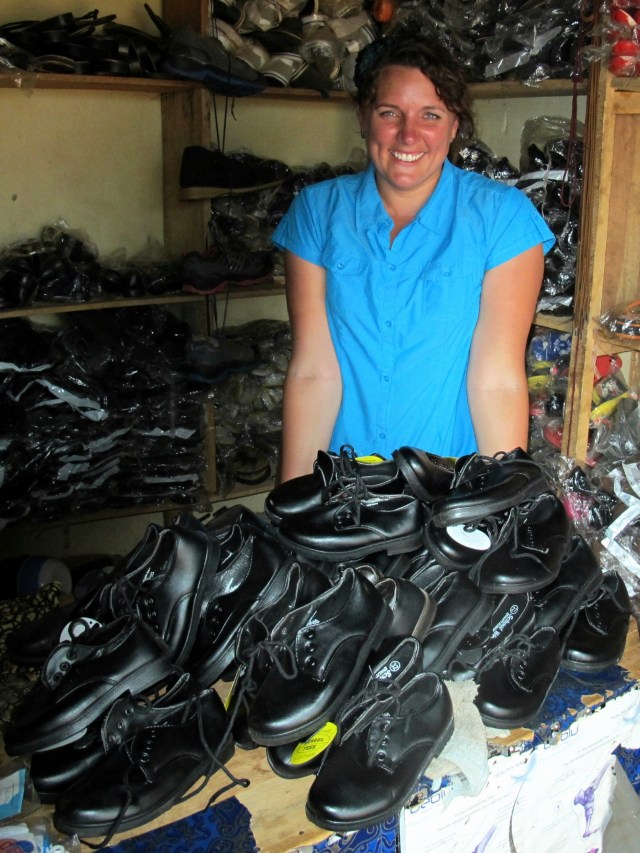
It had barely sprinkled in town and the market was its usual cacophony of colors and sounds. Denis wove his boda through the aisles and stopped at the shoe stall where the vendor was eager to help us. Two by two, I placed the tracings of the children’s feet on the counter and the vendor matched up a new, shiny black pair of school shoes to each tracing. I penned each child’s name on the tag of the shoes, making sure to keep straight which shoes would go to which child.
Twenty-seven pairs of shoes later our work was done and it was time to shell out the shillings that had travelled so far for these shoes. I overheard the vendor suggest in Acholi to Denis that he tell me that the shoes were an additional 3,000 shillings for each pair. She told him he could pocket the extra cash. When Denis replied that he couldn’t do that to me because I’m his Mama, I couldn’t help but well up with pride.
We added 27 pairs of socks to the pile and using three calculators we each checked and double checked the total cost. I laughed when Denis sweet talked the vendor into throwing in a new pair of sandals for him for free. He tried to get a new pair for me as well, but looking at my sack stuffed with little socks and shoes, I told him I already had all the shoes I needed.
Denis hoisted the sack onto the handlebars of the boda and the two of us rode to the hotel.
“Thanks, Denis,” I said sliding off the back of the seat.
“Welcome,” he smiled and held out his hand.
“No, I mean thanks for not overcharging me when you had the chance,” I shook his hand.
“You understood that?”
I nodded.
“Your Acoli is improving.”
“I have a good teacher.” I winked as he handed me the sack of shoes.
“I have a good friend, Hero Lanyero.”
“Apwoyo matek.” (Thank you very much.)
We said goodbye and I lugged the sack of shoes up the two flights of stairs to my room. I flung it on my bed and as the rain pelted the tin roof overhead, I was overcome with gratitude. For Tracy who put this project in motion. For my other faithful friends and family who asked to be a part of it. For Denis who chooses integrity over deceit. For God who has the power to tear the sky with lightning, but cares about the smallest and neediest children right down to the tips of their toes.
“Is there anything you need for the classroom, Mr. Martin?” I looked around the room and immediately thought of half a dozen things off the top of my head. Chalk, chalkboard erasers, pencils, paint, books, bookshelves, crayons. And then there were the bigger things like electricity and running water.
“Thread,” he replied with his constant smile.
“Thread?”
“Or string.”
My puzzled look gave me away.
“I’ve made posters, but have no way to hang them from the bricks and the room is bare. If I had thread or string, I could string it along the walls and hang the posters.”
That afternoon I set off with my trusty boda driver, Denis, in search of thread or twine or string. At our third store we found string for $4,000 shillings, roughly $2.50.
That night as I laid in bed, I couldn’t help but think that if someone had asked me the same question about my classroom, I would’ve rattled off a lengthy list of items I “need”, but all Mr. Martin wanted was string.
A few nights ago, I was listening to a TED podcast featuring Ernesto Sirolli, an Italian missionary. The talk is titled, “Want to help someone? Shut up and listen.” In the talk, Mr. Sirolli tells the story of a mission trip he once took to Africa to teach a village how to grow Italian tomatoes. They brought the seeds and planted the tomatoes and the tomatoes grew to be the size of softballs, but the villagers seemed unimpressed and uninterested in growing tomatoes. The Italian missionaries couldn’t understand the complacency of the villagers when the tomatoes grew so beautifully lush. The night before they were to harvest the tomatoes, a pod of hippos lumbered out of a nearby body of water and ate the tomatoes and tomato plants. Every. Single. One.
The Italians were shocked. The Africans were not. They knew the hippos would come.
Ernesto Sirolli’s point was this, when we assume we know the needs of others and don’t bother asking, we will likely miss entirely an opportunity to truly help. Mr. Sirolli is still a missionary, but he no longer travels with his own agenda. He picks a place and then talks to the locals in bars, restaurants, churches, etc. and asks them how he can help. Then he does something revolutionary: he listens and makes a plan from there.
This TED talk continues to strike a chord with me because I returned to Uganda with a plan and when that plan fell to pieces at my feet, I was left wondering why I’d returned at all. I can’t count how many times I’ve asked, “God, what exactly am I doing here? What am I going to do for almost five weeks?”
Because I’ve been relieved of my own plan, I find myself thinking about tomatoes and hippos and asking people questions like, “What does the school need?” and “Is there a specific student in need and how can I help them?” and “Do you need anything for your classroom?” and “How can I best help you?”
And then I’m doing the exquisitely hard thing: I’m shutting up and straining to listen.
The beautiful thing is that, you-you vigilantes of kindness, are also listening and watching for opportunities to genuinely help.
So far you and I have:
purchased school uniforms for two students who don’t have functioning families to pay for such extravagances
purchased 4 piglets to help Denis raise pigs and earn money to return to school
purchased a set of school textbooks to be kept in the school library for students who can’t afford books
purchased 2 rolls of string for Mr. Martin to hang his teaching posters
purchased a mattress and mosquito net for a student without a bed
And that’s just the beginning. I can’t wait to tell you about the other projects in the works.
The stripping away of my original plan is still painfully raw. I’d like to say that I’m over the disappointment and that I’m done being hurt, but the truth is I’m not. Thankfully the truth is also that there is blessing in this stripping away, blessing in the terrifying willingness to be vulnerable and ask God, “What am I doing here?”
Though I’m the one giving, or giving on your behalf, I’m really the one on the receiving end because the lessons I’m learning are priceless.
Mr. Martin has been working tirelessly to string posters in his classroom and it looks great. Now he teaches from all sides of the room, using each wall and each poster to educate his young learners. I’m so glad I didn’t barge in with armloads of ideas on what I thought he needed when what he really needed most was simply string.
I’m terrified that I’ll return home and when I touch down on familiar ground I’ll forget what I’m learning here. So if you see me with a bit of string wrapped around my finger, it’s because I’m remembering Mr. Martin and Ernesto Sirolli. I’m trying to remember to ask first and then act. I’m trying to remember to shut up and listen. I’m trying to remember that God’s plans are so much better than mine. I’m trying to remember not to plant tomatoes for hippos.
I sat on the back of a boda wrestling a sackful of squealing, wiggling pigs as Denis carefully threaded through the trafficked streets of Pece back to his village. My skirt was slicked with mud and manure and as I grinned from ear to ear and hugged the squirming sack, I thought about the sequence of events that had led me to this exact moment in my life.
This story of Vigilante Kindness begins with my dear friend, Julie, and her husband, Clark. Upon reading the story of Denis, my boda driver, and his quest to have a piggery to earn money to return to school, Julie sent me a message asking how much it would be to buy Denis four more pigs. The amount was sizable in American dollars and an absolute impossibility for Denis to earn in Ugandan shillings. What I love about Julie is that when I told her the amount, she responded with a simple, “Done.”
On the day we were to pick up the pigs, Denis first took me to his village Bungatira, meaning ‘of the forest’. It was a beautiful ride with several stops along the way because Denis had to pick up cakes for me to eat, milk for me to drink and other special things that were quite costly. I watched him shell out his hard-earned boda money in my honor and was humbled to be considered worthy of such sacrifice.
Once off the main road, the trail to the village became more like a single track mountain bike trail and as we bumped along, I smiled at the scenery of the land I’ve come to love-the red dirt that stains my hands and face and washes down the drain in mahogany from my hair, the piercing blue sky like the feathers of millions of bluebirds and the bright green grasses growing up along either side of the trail, flicking against my billowing skirt.
When we arrived at Denis’ compound, I was tickled to see signs posted all over welcoming me to their home. I met his family and toured their farm, which included sugar cane, beans, millet, groundnuts, maize and sweet potatoes. It’s humid in Uganda and I worked up quite a sweat. We reached a creek that runs along the back of their village.
“Do you want to bathe?” Denis felt badly that I was sweating so much.
“I’ll bathe back at the hotel. Really, I’m fine.”
“You fear the water?”
“No, I just don’t bathe in public. I only bathe in private.”
“We bathe here. You can bathe here, too. It’s okay.”
“Coo apwoyo, Denis.” (Thank you, but I cannot accept, Denis.)
“Then let us go back to the house and rest.”
Back in Denis’ thatch roof house, Denis, his older brother Michael and I were served posho, beans, bread made from millet and chicken that was slaughtered and cooked that very afternoon. I drank the milk Denis had purchased along with glass bottles of Mountain Dew that were purchased just for the day.
After the meal Denis’ immediate family all joined us inside the house. Although I’d already met them, I was reintroduced to the family formally and I knew then that I was in sacred territory, in the presence of a family meeting. Around the room they went showering accolades about this amazing gift Denis was to receive. I proudly showed photos of Julie and Clark and their family. Denis’ mother, who had earlier in the day welcomed me with traditional songs and dances, pressed her hands in mine and declared me her daughter. She made me miss my own mother and sent pangs of sorrow through me for Julie who misses her mother every day.
They continued to speak of this great thing I was doing and though I insisted it wasn’t me-that it was all because of Julie and Clark-they kept saying that it was only possible because of me. Michael, Denis’ older brother, translated their words of kindness to me and told me it was no use deflecting them because I was the vehicle for Julie and Clark’s great generosity. Over and over again, they clapped their hands in appreciation and I sat quietly and took it all in.
I fell in love with this sweet family who had gathered together to celebrate this second chance for their son. I especially fell in love with the eighty something year old parents who still tend to the crops. When Michael bragged about how bright Denis was when he was in school, I thought of Clark who, on the other side of the world, was at that very moment preparing for his own brother Michael’s funeral. The thought of these two sets of brothers honoring each other in such different, yet loving ways brought me to tears and when I told Denis’ family about Clark’s loss they sat in sorrow with me for Clark.
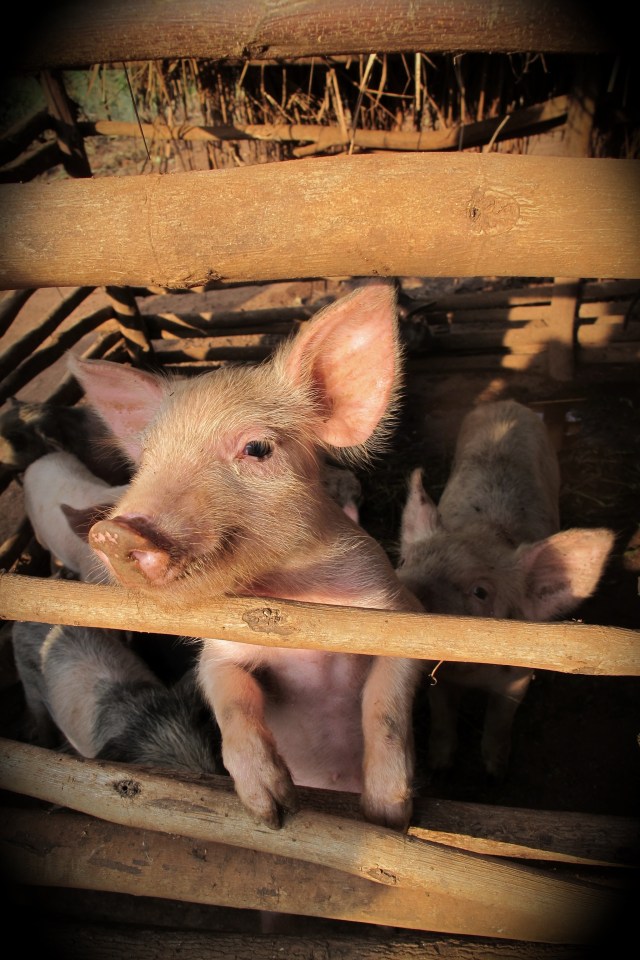
The family sent me off with their sincerest sympathies mixed with their profound thanks and then Denis and I hopped on his boda to go purchase the pigs. The ride to the farm was a long one that wound away from the villages, back through Gulu and into Pece, the home of the famous Pece soccer stadium. At the farm Denis climbed into the pig stall and selected his four new pigs, three females and one male. He placed them in a sack and then tied the top of the sack making sure there were breathing holes. The woman selling the pigs stepped inside the house to get her receipt book and I slipped the money into Denis’ hand so that he could be the official purchaser of the pigs.
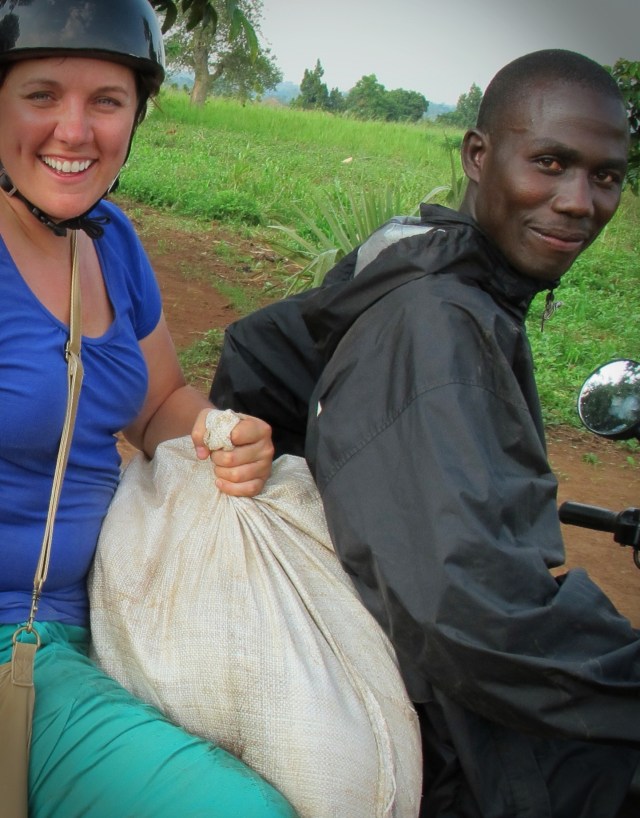
Denis sat on the boda and I straddled the back of it, leaving a space in between for the sack of piglets. The woman hefted the sack into my lap and the squealing pigs wiggled and grunted as they tried to get comfortable for the ride. The sack was covered in mud and manure which as we rode back through Pece ground itself into my skirt and covered my hands as I held onto the precious cargo.
“Are you okay? Do you want me to call someone else to help me take the pigs home?” Denis asked me for the millionth time.
“I’m fine. When else am I going to have a chance to carry a sackful of piglets on the back of a motorcycle? Never.”
“Sure?” Denis grinned at me in the rearview mirror.
“Sure. Let’s get your new pigs home.”
We bounced along the road and I spoke sweetly to the squealing pigs trying in vain to calm them down. Several times I felt pig hooves and snouts poking out of the air holes and smiled at the Ugandans laughing at what must have been a comical sight, a muzungu woman wrestling a bag of pigs!
Back at Denis’ village the family greeted us again and helped unload the new pigs into Denis’ piggery, which he’d renamed the ‘Hellisha Project’. (On a side note, Hellisha is the most fantastic misspelling of my name ever. Hellisha will now be the name of my alter ego.)
The women in Denis’ family tsked over my dirty skirt and Denis looked at it in alarm.
“You must take it off and let me wash it.” Denis insisted.
“It’s fine, Denis. I’ll wash it when I get back to the hotel.”
“No, you must let me wash it.” Denis insisted.
“Coo apwoyo.” I replied.
“You must.”
“Denis, it would not be appropriate in my culture for me to sit in my underpants while you washed my skirt. Thank you, but I truly cannot take my skirt off.”
“You cannot move around town like that.”
“I will wash these clothes and put on another pair before I move around town.”
“You’re sure I cannot wash your skirt?”
“Absolutely.”
“Then I’ll take you back.” We said our goodbyes to the family and again rode back into town.
That night as I sat in my hotel room bathroom scrubbing my skirt clean, I couldn’t help but smile at all the cultural differences I’d encountered that day. I hung my skirt to dry and showered off the sweat and dirt from the day. Rivulets of red mud dripped down my legs and swirled down the drain and I thought of how at the end of the day we are so much more the same than we are different.
We are friends who laugh together. We are loud families who gather for a meal. We are brothers who love each other through life and beyond. We are mothers and fathers who work hard to provide for our children. We persevere in the pursuit of education. And on our best days we see the need of a stranger and place it above our own needs. On our best days we are Julie and Clark.




 Vigilante Kindness