Vigilante Kindness: Ivan’s Paintings

“Alicia, will you buy one of my paintings?” Ivan chuckles shyly. He laughs like the cartoon character Goofy and I giggle each time I hear his laugh. “I need to earn some money to buy school supplies and some more art supplies.”

I love this kid for wanting to earn money instead of asking for a handout.

Ivan is one of my favorite kids from this year. A few years ago Ivan and his younger sister were taken in by an American couple. Ivan didn’t have a father in his life and after a tragic accident his mother was left mentally disabled and unable to care for her children. She now lives in a care facility in another part of Uganda. Ivan calls the American couple his parents. When his parents had to return to the U.S., they left Ivan and his sister with a house to live in. His parents send money for the house, for bills, for food and for schooling. Ivan keeps a detailed account of the expenses and he reports it back to his parents every month. Any extra things Ivan needs, he pays for himself by selling paintings out of the art studio at his house. When Ivan and his sister finish school here, they will join their parents in the U.S., where Ivan hopes to attend a university and major in art.

“I’d love to buy a painting, Ivan. Do you have them here?” It matters little to me if his paintings are any good.

“No, but I’ll get them from town and show them to you. I’ve got four finished paintings, but I want to give one to the Vice President of our school when he visits.”

He brings the paintings to school and we go behind one of the classrooms where he lays them out on the ground. They’re good.  I immediately know exactly which one I’m going to buy for myself. It’s a small painting of the word LOVE with Africa in place of the O.

LOVE by Leku Ivan
LOVE by Leku Ivan

What Ivan doesn’t know is that I’m using Vigilante money to buy the other two remaining paintings.

I pick up the LOVE painting and the two other paintings. “I’ll buy these three, Ivan.”

“Three? Really?” His Goofy chuckle rolls up from his belly.

“Yes, three. How much do I pay?”

“Anything is fine.”

“Ivan, I want to support the work you’re doing as an artist. So think of a price that’s fair for both of us and that’s what I’ll pay.”

Ivan takes a few minutes to think. “Is 200,000 shillings okay?” I do some quick converting in my head. He’s asking for roughly eighty American dollars. I pull shillings out of my wallet for the smaller painting and use Vigilante shillings for the other two paintings. We shake hands and both of us leave feeling like we got the better deal.

In even more exciting news, after seeing my LOVE painting another friend in Africa is commissioning Ivan to paint a similar one for her. My sister is also going to help Ivan make and sell prints of his paintings. Again, one small act of Vigilante Kindness snowballed into something even greater.

When I bought Ivan’s other two paintings I honestly didn’t know what I was going to do with them. I just knew that I wanted to support Ivan and his budding art career. Later in my hotel room as I spread the paintings out on my bed, an idea came to me: I’d give them away to my fellow Vigilantes of Kindness. The only problem-and it’s an incredibly good problem-is that I only have two paintings and I’ve got way more than two Vigilante donors.

The two paintings up for grabs are the two closest to the love painting.  One is a vertical tree painting.  The other is a landscape with elephants in the foreground. I'll take better photos when I get home.
The two paintings up for grabs are the two closest to the love painting. One is a vertical tree painting. The other is a landscape with elephants in the foreground. I’ll take better photos when I get home.

So here’s how it’s going to work, for every dollar you donated, you’ll get a ticket in the drawing. So if you donated $20, you’ll have 20 tickets in the drawing. If you donated $200, then your name will be on 200 tickets and so forth. I’ll do the drawing on September 30th. That will give me time to take photos for making prints.

This is also good news for those of you who wanted to be Vigilantes of Kindness, but weren’t able to because you offered to donate when I was already making my way back home. You can make a donation and be entered in the drawing as well. (Message me for details on how to donate.) Any new donations will go toward my return trip next year and the Vigilante Acts of Kindness that are yet to come.

I’m absolutely giddy at the mere thought of returning to the land I love and exacting more kindness for the sake of being kind. I look at Ivan’s LOVE painting and wonder just what’s going to happen next in my love story-our love story-for Uganda.

Magnificently Ordinary Acts of Vigilante Kindness

Sometimes committing Vigilante Acts of Kindness in Gulu involved really glamorous things, the kinds of things that look good in photos, like buying shiny new shoes for 30 kids or wrestling a manure filled sack of piglets on the back of a boda. Like I said, really glamorous stuff.

Other times, the Vigilante Acts of Kindness were magnificently ordinary. Basic needs that were met because I didn’t have my own agenda and instead took time to ask, “What do you need and how can I help?”

I spent an entire day in Gulu town with the head teacher JB and my trusty sidekick, Denis, making sure some of those basic needs were met.

The first item on our list was to buy fencing materials. The boys dorm on campus backs up to a road and JB had been losing sleep at night because the road provided the perfect opening for trespassers, of both the animal and human type, to enter campus.

“So let’s go buy a fence, JB,” I shrugged.

“It will be expensive and we will have to rent a truck to transport the materials.”

“I think I’ve got enough donations, but write down your estimate and let me make sure.”

After a few quick calculations, JB shows me a number. It’s sizable, roughly one hundred fifty American dollars, a small fortune here in Uganda.

“That’s no problem.”

“I didn’t include the truck,” he scrawls another number and shows it to me. A truck rental will be 40,000 shillings, or roughly sixteen American dollars.

image

“That’s fine, JB. What else does the school need?”

“I still have many textbooks that we need for the library.”

“Let’s get those while we’re in town and you can throw them in the truck, too.”

“Are you sure you’ve got the money?”

We purchased over 50 textbooks.

“Yes, and I’m running out of time to spend it. What else does the school need?”

“Well, the primary kids need readers and some workbooks. And teachers need pencils, pencil sharpeners, markers and chart paper.” JB waits for me to say no, but with a wad of Vigilante shillings stuffed in my purse, my mouth is full of yes.

School supply shopping is so much more fun on a motorcycle.

“Good. Let’s get that stuff while we’re in town and toss it in the truck, too. I know the students need ringworm cream, so I’m going to go talk to Mama (the dorm mom) and see what other medicines she’s short on.”

Mama is all smiles when I ask her to make me a list. She doesn’t hold back and I love her for being so candid about the needs of the students.

On the day we hit town to pick up all these things, I love Mama even more for adding yeast infection kits to her list. Watching Denis turn thirty shades of red while he translated that one to the pharmacist was worth ever shilling!

How do you say 'yeast infection' in Acholi?
How do you say ‘yeast infection’ in Acholi?

On my last day at the school, Mama found me and invited me into her living quarters at the far end of one of the girls dorms.

“Hi, Mama. Itye maber? (How are you?)” I sit in the plastic chair she’s brought out for me.

“I’m fine. Thank you for buying medicine for the students. Five girls have already made use of the feminine medicines.” She sits down across from me.

“Mama, you already thanked me. Three times. I’m glad the medicine is helping.” I pat her hand.

“You’re different, Alicia.”

I don’t really know how to take that one. Different like the kid who eats paste kind of different? Sometimes compliments here are hard to swallow, like how being called fat is a good thing because it symbolizes wealth.

“You’re different than other muzungus who come here. You asked what we need and then you took action.”

“Thanks, Mama. It’s a lesson I’m still learning with lots of help from the people at home.” I look down at my hands.

Mama’s right, I am different. I’m different than the person I was when I arrived. I’ve tried to heed Ernesto Sirolli’s wonderful, if not eloquent, advice to ask what people need and then shut up and do it. No more planting tomatoes for hippos.

“Greet the people at home and tell them thank you for me,” Mama hugs me tight. She’s soft and I see why the kids have such deep love for her.

“I will, Mama.”

I leave campus that day knowing that I’m leaving my kids in good hands. I’m leaving them in hands that daily commit magnificently ordinary acts of kindness without fanfare or fuss. I’m leaving my kids in Mama’s hands.

image
Mama


Vigilante Kindness: The Secrets We Keep

“I found out a secret about you today,” I smile and tease.

The boy’s face drains of color. I’ve forgotten that I’m in a land where secrets are buried deep in the blood stained soil, where secrets are nightmarish memories to be escaped in the waking hours.

I feel my face redden at my thoughtless blunder. “It’s a good secret. I found out that your friend is a waiter at my favorite cafe in Gulu town. See?” I hold up my iPad. “He sent you a video.” I press play and the friend’s face comes to life.

He finds me again later that same day. “Alicia, I need to talk with you privately.”

“Okay.” I search his face, but I don’t recognize this expression. Fear? Shame? Worry? I can’t break the code. “Do you want to talk now?”

“Tomorrow.”

“Tomorrow then.”

Tomorrow arrives and admittedly, I’ve forgotten about the private conversation we need to have. I speak with him every day, mostly in relative privacy, so his request hasn’t taken root in my memory. I see him and wave, greeting him in my laughable Acholi.

He does not greet me in return. “Can we talk now?” He doesn’t wait for my response. Instead he guides me by the elbow into an empty room where we sit side by side.

“I have to tell you a sad story about myself. I want you to be prepared.” He is serious.

I’ve heard lines like this my entire trip. The stories here are all sad and the stories always end with a request for money. The stories are often elaborations of the truth, hungry attempts to escape poverty via pity. I take a deep breath and formulate how exactly I’m going to say no this time. It is a jaded side of myself, one I need here and one I simultaneously loathe.

“When I was younger, there came a day when I was playing with a certain friend near a mango tree. That friend climbed the mango tree and fell out of it, breaking both of his arms.”

“Sorry.”

“There was blood everywhere and so I picked him up and carried him to get help.”

“That sounds like you.”

“I lost track of this certain friend until he called me sometime ago to tell me he is HIV positive and that I’d better get tested as well.”

“Did you?”

“Yes.”

“Are you HIV positive?”

His eyes are downcast and when he raises them, I know the answer before he says it. He swallows hard. “Yes. And I’m starting to have many pains and sicknesses.”

“I’m so sorry,” I put my hand on his back.

“I’ve known for some time now. I wanted you to know because I’ve not been doing well and you’re leaving soon and if I’m not,” he pauses, “if I’m not here when you return, I wanted you to know why.”

I don’t know what to say. Or do. Sorrow rises in a wave of heat from my stomach and it’s all I can do not to vomit. “You’re sure? I mean, you had a second test to confirm?”

He nods. “And a third.”

“What does your family think? Are they helping you get treatment?”

“They don’t know.”

“Why not?”

“If I tell them, I’ll be excommunicated from my clan and won’t be able to go to school.”

I find myself wishing to God that he’s lying about the HIV and about his family. He’s not. “What are you going to do?”

“Live out the rest of my life.” He looks at his hands.

“Are you afraid?”

“Afraid of HIV? No, I already have it so fearing is of no use. I fear dying before I get to fulfill my dreams. Do you fear HIV?”

“Yes,” the word catches in my throat and I choke on the painful truth of it.

“Do you fear me?” He looks out a window.

“No.” It’s an easy answer. “No, I don’t, but I, too, fear you dying before you fulfill your dreams. I really want you to consider treatment.”

“Treatment is expensive and my test records were lost in a storm that took the roof off the hospital.”

“You need to get tested again.”

“I can’t pay for the test.”

“I’ve got that covered.”

“Will you go with me?” His voice is small, scared.

“Yes.”

“And then what?” He clears his throat and blinks. I pretend not to notice the sheen in his eyes. He hopes I have a plan. I don’t.

“After we get the results, we’ll have to figure something out. I don’t really know what.” The truth feels paltry here, but I can’t make empty promises. We make arrangements to meet at the hospital Friday morning.

That day on the ride home, I cry and cry on the back of Denis’ boda. Denis is quiet and just lets me cry. I think of the boy and all the things I love about him. He is honest to a fault and loyal down through the marrow of his bones. The other day I watched him raise the flag and back away in reverence. I love this boy and the thought of HIV running rampant inside him is more than I can take. I catch a glimpse of myself in Denis’ rearview mirror. My tears have left trails through the dirt that bronzes my face.

I toss and turn Thursday night and can’t stomach breakfast Friday morning. I call Denis to come and get me and on the ride to the hospital I’m quiet. Denis knows the reason for my trip to the hospital and he tries to cure my sadness with lighthearted conversation. My responses are brief as I tamp down the urge to vomit. It is the feeling I get each time I grieve, and I am grieving with such weight for this nineteen year old boy.

My phone rings as the wind whips through my hair on the back of the boda. It’s the boy. He’s reached the hospital early and is waiting by the gate. He couldn’t sleep either. At the gate I shove a fistful of shillings in Denis’ hand and I meet this sweet kid at the gate.

We enter and I follow him up a flight of stairs. He’s wearing one fluorescent green sock and one fluorescent pink sock. With his black slacks and pressed blue button up school shirt, the socks are ridiculous and I stifle a giggle. The socks peek out over the tops of his shoes and I am reminded that he’s just a kid. He later explains that he got dressed in the dark before the sun was up and couldn’t see what socks he was putting on.

The hospital grounds are covered with patients who have laid out papyrus mats and their wash bins. They are a patchwork quilt across the grass, along every sidewalk and under every overhang. Their clothes hang from lines stretched across the grass, brightly colored garments snapping like prayer flags in the wind. There are no empty rooms for these patients.

I’ve never seen so much need before and as I follow the boy, I say a prayer for the people in this hospital and also a prayer of thanksgiving for my own health.

We wait for the doctor who has not yet arrived. We wait for hours. After the doctor arrives and performs an examination, we walk to a different part of the hospital for the HIV test. We wait again for hours. The waiting is excruciating.

The hospital walls are crumbling and rusted. The building itself looks as if it’s dying, succumbing to mold creeping up the sides and covered by the film of acrid red dirt that blocks light from entering the windows.

Everywhere there are babies, hundreds of babies, tied on the backs of their mothers. ALL of the babies are wailing. Ugandan babies never cry so the sound is unbearably upsetting.

We sit by the door of a room with a solitary word painted above the door frame. “Counseling”. I steel myself for counseling on treatment options for this boy to extend his life as long and as fully as possible.

The doctor arrives and we enter. After a brief conversation, the doctor pricks the boy’s finger and squeezes a drop of blood onto a test strip. We remain in the room, waiting to see the pink line that indicates HIV appear. We wait only minutes, but it feels like centuries. I don’t realize I’m holding my breath until the doctor says to the boy,”You’re HIV negative.”

The boy and I exhale, but neither of us speak.

“Are you sure?” My voice barely surpasses the lump bobbing in my throat. “I mean how sure are you?”

The doctor digs in the waste can and pulls out a test from yesterday. “See how this one has a pink line running through it? This person is unfortunately HIV positive. See how your test doesn’t have any lines running through it?” The doctor holds up both and the boy and I rise out of our seats to get a closer look.

The boy sputters, “But three times I was tested and they said I was positive. How can this be?”

“Did you remain in the room while they were getting the results or did you wait outside?” the doctor asks.

“They made me wait outside. Twice over there in that room,” the boy points to another building in the hospital, “And once at the hospital in my district.”

“I’m guessing they made a mistake.”

“Three times?” the boy and I speak in stereo.

“Usually we only administer a second test if the first is positive, but I’ll administer another one right here so you can see for yourself. This one is a little more expensive though.”

“I don’t care.” I grab the boy’s hand and shove it toward the doctor so he can sample another drop of blood. He pricks a different finger and squeezes a drop of blood onto the test.

We wait triple the recommended minutes, just in case. We don’t take our eyes off the test strip. We don’t even blink.

The test is negative.

The doctor shows us a positive test and the results are black and white.

The boy does not have HIV.

The boy and I spring out of our chairs and hug each other. We jump up and down and laugh and hug and tears of joy squirt from our eyes. We carry on like this for a lengthy period of time. The doctor smiles at us.

“Alicia, did you bring your camera? Take my snap with the doctor.” The boy stands and straightens the tie of his school uniform. He puts his arm around the doctor. They are both grinning from ear to ear in my camera lens.

“Doctor, I’m sorry to be so ignorant, but do you have a medical explanation as to why he’d test positive so many times and test clearly negative today?” I want to believe, but I don’t. I want to put my finger in nail holes. I hear myself thinking a familiar prayer. Lord, I believe. Help my unbelief.

“My guess is that it was human error mixing up the test results. That’s why we now do this test right in front of the patient.” The doctor pauses, “Then again, miracles do happen.”

“I don’t care which it is! This is the greatest day in my life!” The boy hugs me and hugs the doctor again.

We still have to visit two other places in the hospital, one for a Hepatitis test (which turns out negative as well) and lastly to return to the first doctor for a final consultation and for some antibiotics for a couple of smaller issues. We leave the HIV counseling office and practically skip to the next building. I watch the pink and green socks flash from underneath his pant cuffs. I am smiling so hard that my face aches.

At the end of a very long day, the boy leaves the hospital with antibiotics. I leave with approximately forty-five fewer Vigilante of Kindness dollars and we both leave with the knowledge that the boy gets a shot at living a long and healthy life to pursue his dreams.

“This is because of you. You should hang onto this,” the boy shoves his HIV results paper into my hand.

“You need to keep it. I hand it back. You need to keep your medical records as proof of the tests they did today.”

“As proof that I am healthy,” he smiles.

“You should share this good news with your family.”

“I can’t,” he hangs his head.

It pains me that he couldn’t share the heavy burden of being infected with HIV, but it breaks my heart in a new way that he can’t share the lifting of that burden.

I pause for a moment, thinking about the secrets we keep, thinking about how when the boy returns to school, he won’t share this news with another soul.

We part ways at the hospital gate. He takes a boda back to school and I ride with Denis back to town. I stare back at the hospital sign, “La Cor Hospital”. I’m reminded that ‘cor’ means heart and my heart overflows.

A few days later, I’m saying my goodbyes at the school. I can’t find the boy anywhere. As I’m walking toward Denis to ride back to town, I see the boy running toward me. I run, too. We hug and I fight back tears.

“I was at home today. I’ve just returned and I thought I’d missed you,” he says catching his breath.

“I thought I was going to miss you, too. Why were you at home?”

“I told my parents.”

“And?”

“They were happy for me,” he grins. “I don’t have the words to thank you. I just don’t have the words.”

“It’s okay. You can thank me by pursuing your dreams all through your long and healthy life.” I squeeze him tight.

“I will.” He hugs me one last time. “I promise,” he smiles and I know that the boy with the mismatched socks, the boy who is honest to a fault, the boy who revels in the majesty of the flag is going to spend the rest of his life doing just what he promised me.

Vigilante Kindness: Doing It Wrong

“Peter Paul Opok Road. That’s where the gallery moved to.”

“I do not know that road.”

“A road you don’t know? I never thought that would happen.” I poke Denis in the back.

“I will find out. We will go.” Denis speaks to some men building bed frames by the just moved sign hanging by the old studio/gallery. He returns a minute later. “Okay, I know.”

We speed to the back side of town, curling in between traffic and pedestrians along the muddy road. I’m going to miss riding on the back of motorcycles. I tip my face to the sky and let the sprinkling rain hit my cheeks.

My favorite artist, Omuny, is in residence and she has new pieces hanging all over the walls. She’s been busy since last summer. Behind the counter is a stack of paintings leaning against the wall.

“Are those for sale?”

“Yes. I just haven’t put them out yet.” Omuny motions me behind the counter and I flip thorough the stack.

imageThe moment I see it, I know it’s the one for my artist sister. Supporting a local artist is the perfect way to spend the rest of her Vigilante donation.

“I’ll take this one, please.” I hand it to Omuny who removes it from the frame and rolls it for me.

I carefully count out bills and I squeeze them tight in my hand. She hands me the painting and I shove the wad of bills in her hand, practically running out the door. I grab Denis’ sleeve and pull him out with me. “Quickly, quickly let’s go!” I can barely control my giggles.

We speed away and from the back of the boda I see Omuny hurrying out the door toward us.

“How much did you pay for that?” Denis calls back to me.

“Enough.”

“Did you barter with her?” Denis wrinkles his brow.

“Nope.”

“Did you pay the asking price?”

“It’s so much worse than you think.” I turn and wave at Omuny. She waves back and smiles.

“Tell me.” Denis is stern now.

“I paid her double!”

“You’re doing things all wrong.” He shakes his head at me, like he so often does.

“I know.” I can’t suppress my grin.

Back in my hotel room I unroll the painting. I take a snap and giggle at the thought of Omuny counting out the money and finding I’d paid double the asking price. I AM doing things all wrong this trip and my heart feels so completely right.

Vigilante Kindness: Shiny New Shoes, Part 2

If you’re just joining the story of Shiny New Shoes, you can read Part 1 here.

Denis hoisted the sack of shoes onto the front of the boda. Monday morning had arrived and that meant it was time to pass out shiny new shoes to the P1 students and to the children living on campus. Although the road was clear and Denis zipped along, the ride to school seemed interminably long.

Finally we reached the campus and Denis hefted the sack off the boda. I enlisted the help of my son, Geoffrey, and two of my young writers from last year, Richard and Johnson. Together we lined the shoes up on the step outside of the classroom, each pair with a child’s name carefully penned of the tag. 27 pairs in all.

image

Half an hour before school was finished Mr. Martin brought the class outside and I called out the name of each and handed them their shoes, Mr. Martin and my three older student helpers stood ready to help tie all those shoes.

When I handed each student their shoes and a bright white pair of socks, they were too surprised to speak. The took the shoes and then in a bit of a daze, they got help putting them on. I’ve seen this dazed look before on my own first grade students when we went on field trips that were so amazing that all they could do was stand there and take it in.

One little one said, “Thank you” as I handed her a pair of shoes and the rest of the children remembered their manners and followed suit, thanking me in their best English.

image

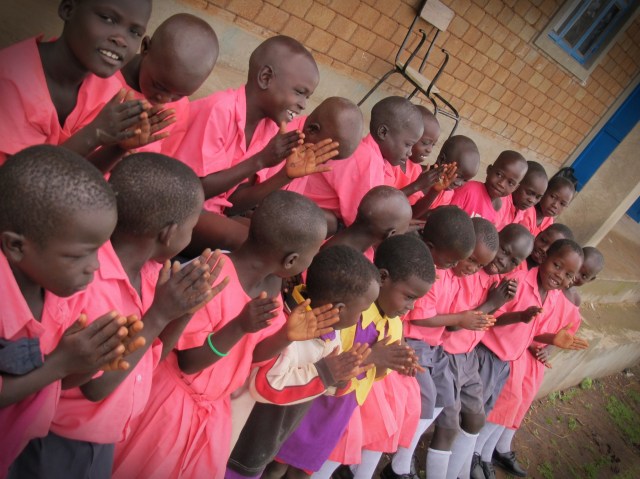
When everyone had been given their new shoes, it was time for pictures. Some of the kids grinned so widely that I was sure I could see every single tooth. Others were still dazed. They sang their goodbye song and I recorded a bit of it to show the donors and then clapped to show their appreciation.

image

When Mr. Martin dismissed them to go inside and stack their chairs and go home, they stomped up the stairs, giggling at the sound of their new shoes on the pavement. I laughed as they stomped up a storm and when they came back outside, every single child stopped to shake my hand and say thank you.

As they walked off campus, I watched them carefully avoiding mud puddles to keep their shoes shiny and clean. One little girl stopped every few feet to dust off any specks of dirt that got on her shoes. I can only imagine how long it took her to walk home that day!

image

Another little girl could not wear her new shoes that day. In all my days on campus, I’d never seen her wear shoes. She had a wound on her foot from walking everywhere without shoes. She is the reason this Vigilante Act of Kindness was so needed. She’s the reason why I’m so appreciative of all the Vigilantes who made this shoe project possible. I watched this little girl walk home, cradling her new shoes carefully in her arms. I saw her again two days later wearing her new shoes, protecting her precious feet, and couldn’t help but smile in gratitude for my friends and family who had offered of themselves to provide her with shiny new shoes.

There is a musee (an elder) who stands guard at the front of the school. His English is as good as my Acholi, a fact that we laugh about daily. When Denis picked me up from school that day, the musee stopped me. He shook my hand and in words I think he’d been practicing all day, he said, “Well done, Madame. Well done.” So to my fellow Vigilantes of Kindness, I pass along his words and with a full heart I say to you, “Well done, friends. Well done.”