Vigilante Kindness: A Gift From Oregon, Part 3

If you’re just joining the story of A Gift from Oregon, you can read Part 1 here and Part 2 here.

My stomach was a ball of nerves, like one of those giant office supply rubberband balls snapping and bouncing between my ribcage.  The ride to Bungatira took me way outside of Gulu, past several villages each boasting a small roadside store or two.  Boda drivers waiting to carry fares sat parked along the road and clustered on the corners.  Mothers and children sat selling the riches of their gardens and the children called out, “Munu!  Munu!”  I waved and smiled at their innocence, but the rubberband ball in my gut continued to ping-pong off my insides.

Denis was his usual chatty self, but I couldn’t help but remember my last visit to Bungatira.

The pain of seeing discrimination against people with mental illnesses inked so clearly on their community Constitution.

The anguish of sitting beside my son during talk of child soldiers returning from war changed for the worse.

The feeling of wanting to run away.

The burning sensation in the very core of my being that made me stay and speak up for my loved ones.

The community members who walked out of the meeting.

The tears that fell in the red dirt when I spoke about my loved ones struggling with mental illness and the searing pain that they wouldn’t be welcomed in this group.

The heartfelt apologies for causing me pain.

And finally the blissful relief of seeing those discriminatory words removed from the community Constitution.

This time I returned with a purse full of shillings for the Bungatira community group.  640,000 shillings from my friend Jenna who had been so moved by their willingness to change that she bequeathed $250 raised by her Oregon Vigilantes of Kindness to the group in Bungatira.

The money would go towards helping them start a savings and loan program, wherein group members could borrow reasonable amounts and pay them back with interest.  The people of Bungatira would now be able to take out loans to pay their child’s school fees.

Inside my purse beside my fat stack of shillings was my iPad.  On it I had pictures of my loved ones who struggle with mental illness and pictures of Jenna and her loved ones as well.  I’d go and share our stories, share that we too are mothers and wives battling on our knees alongside our loved ones.

Donald M. Murray, one of my favorite writers and writing teachers, once said, “The more personal I am, the more universal I become.”  As Denis steered us closer to Bungatira, I prayed that would be true.  I prayed that in sharing the stories of my life and explaining what compelled Jenna to choose Bungatira to receive the money from Oregon, the people of Bungatira would see the very personal side of the universal issue of living with and loving people living with mental illnesses.  I didn’t want to be another white person advising them on what I think is best for their community.  I wanted to be Lanyero Alicia, a woman and a friend who has walked some of the same paths they’re walking and has come out scarred, but stronger for having chosen to love when it was painful and to fight for my loved ones when they couldn’t fight for themselves.

But, Lord have mercy, that was a tall order and the closer we got to Bungatira, the more it felt like I wasn’t up to size.  The sky turned from blue to pallid gray, the perfect match to my unease.

We first stopped at Denis’ brother’s store in Bungatira where a local women’s dance troupe were preparing to perform underneath a mango tree behind the store.  Denis had asked them there in my honor and these women were stunning, absolutely stunning.  They were dressed in every color of the rainbow with bells tied around their ankles.  Two men brought out drums and these beautiful women sang and danced with such strength that my heartbeat began to keep time with their songs.  I’m told they didn’t sing a prayer for rain, but the rain came nonetheless and the women kept on dancing.  I couldn’t snap photos quickly enough.  I marveled at their feet, so tough from everyday life, so exquisite as they danced in time together.

1011601_10200432330557836_1776371632_n

The rain came down in sheets and we moved underneath the overhang in front of the store.  The women kept dancing and singing, their voices rising over the rain, which drowned out the thumping ball of nerves in my belly.  After the dancing, we ate cookies and drank soda with the women.

When the rain let up, it was time to complete the journey to Bungatira.  On the back of Denis’ motorcycle, I took deep breaths and listened to the greenery thwapping against my skirt as the road grew narrower.  Upon reaching Denis’ compound, the community group gathered and I sat in a plastic chair with the officers of the group.  Denis’ brother, Michael, sat beside me ready to translate.

They opened the meeting with a prayer and after a few short words, I had the floor.  Gulp.  I looked into their eyes and they into mine.  With a final deep breath, I began to speak, first thanking them for inviting me back and then the time came to share my story of loving people with mental illnesses.  I willed the lump in my throat back down as I spoke and barely contained tears as I spoke of a particular loved one living a happy and healthy life with bi-polar disorder.  Michael translated that my loved one is now happy and healthy and the group gathered on papyrus mats at my feet broke into applause.  I smiled and showed photos and then told Jenna’s story of loving someone through post traumatic stress disorder.  They clapped and cheered when I told them that fatherhood is helping this particular person heal from PTSD.  They clapped and cheered like our loved ones were their loved ones.  The ball of rubberbands in my stomach settled as my heart filled.

I explained that because they’d changed their constitution to include people struggling with mental illness, Jenna and the Oregon Vigilantes had sent me with money for their savings and loan program.  I presented all 640, 000 shillings to the Treasurer and again, the people of Bungatira broke into applause.  Denis spoke kind words over me and I deflected them, insisting that the money was because of the changes they’d made not because of anything I’d done.

Denis introduced me to a man and his daughter.  The man is a single father and his daughter had epilepsy and autism.  Denis explained to me that when the father heard the group was accepting people with mental illnesses, he and his daughter had joined immediately.

Denis’ words were like a punch in the gut.  For them, the term “mental illness” also encompasses mental disabilities.  Oh God.

I found myself struggling for breath.  I thought of all the kids with special needs who I’ve fought to include in my classroom, all the meetings where I’ve gone toe to toe to fight for their rights.  To find the fight here in the African bush had knocked me off kilter.

I looked at the man and his daughter sitting so proudly as official dues paying members.  Equals with equal buy-in and equal power.

“I’m so glad you’re both here.  It’s a pleasure to meet you.” I met the father’s eyes.

Michael leaned in and explained to me that since the man and his daughter had joined the group, the people of Bungatira had met to see how they can help him raise his daughter and keep her safe.  The women are teaching the girl to cook and the men of the community are acting as her extremely protective big brothers.  They have surrounded the man and his daughter and enfolded them into their own families.

After a day of holding back tears, I let them fall freely.  I cried for the beauty of it all and for the fact that I got to play a small part in this story.

I stayed in Bungatira until nightfall when Denis’ family sits nightly around the bonfire and roasts maize.  The bonfire is where they gather as a family and address any concerns.  It’s a sacred time and as one of the children crawled into my lap, I knew how fortunate I was to be included.  I sat in their inner circle and listened, gazing up at the sky which had cleared and given way to millions of blinking stars.

On the boda ride back to town, I felt a particular sadness leaving Bungatira and her people.  I held their faces in my mind and closed my eyes to the wind on my face.  Denis told me several times during my trip that I was changing the world, but leaving Bungatira for the last time, I knew that I was the one who was forever changed.

Vigilante Kindness: This We Believe

Hi, guys.  I’m re-posting this with the slideshow that served as the finished product to this writing workshop.  It was really interesting to see which beliefs the student writers chose for the slideshow and equally interesting to see which ones they didn’t choose.  The finished product is about eight minutes long and leaves me teary-eyed each time I watch it.  I’m so proud of these kids and am honored to call them mine.  

Storms and power outages here have been intermittently casting the evenings into quiet darkness. Malaria is fever has struck several people I know and ringworm is leaving its itching, festering mark on the faces of the kids I love. Life is hard here and I know I’m only scratching the surface.

Last Saturday I held a voluntary writing workshop for the high school kids at the school. There were about fifteen writers including students, myself and two teachers from Sweden who I’d met in town and wanted to join in the fun. We were a small, but mighty group of writers and we tackled the topic of writing about our beliefs, using Tarak McLain’s This I Believe essay as our model. We brainstormed topics to write beliefs about and the students chose to write about God, love, education, friendship, life and then they added on any other beliefs they felt strongly about

imageOne of the student writers summed up the last couple of days perfectly when he said, “Life is demanding in terms of keeping good health.” It is so very demanding and I’m on my face grateful for my own health.
Maybe you or a loved one are facing the demanding battle of fighting for the precious gift of health. Maybe you feel a bit in the darkness as of late. Maybe your spirit is feeling impoverished. I know mine has been as of late.

Last night as lightning and thunder struck simultaneously in the sky above me, I sat under the light of my flashlight reading the beliefs my students had penned. I was reminded that hope rises above darkness. Hope rises above disease. Hope rises above poverty. Hope rises. Period.

Need proof? Here are just some of the beliefs they wrote that are striking all kinds of chords with me.

This I Believe about God:

  • I believe God is our breath.
  • I believe with God we can do better.
  • I believe God is my best friend.
  • I believe in God’s mercy.
  • I believe God can do wonders in our lives.
  • I believe God gives us unique gifts.
  • I believe in the miracles of God.
  • I believe God can feel my heart.
  • I believe God is always present in me.

This I Believe about Friendship:

  • I believe a friend who encourages is a friend of great value.
  • I believe friendship without trust is nothing.
  • I believe friendship is a choice.
  • I believe friendship is magical.

This I Believe about Education:

  • I believe education is boldness.
  • I believe education needs one heart.
  • I believe education is a way to tour the whole world.
  • I believe education gives us hope in the future.
  • I believe education can eradicate poverty.
  • I believe education can stop violence in homes.
  • I believe in education as a solution to ignorance.
  • I believe education builds up the family.
  • I believe education is for everyone.
  • I believe education is the best gift my parents can offer me.

This I Believe about Love:

  • I believe love fulfills.
  • I believe love never hates.
  • I believe without love, I am nothing.
  • I believe love is what you show.
  • I believe love is life.
  • I believe love makes us stay in peace.
  • I believe if you have love, you won’t kill.
  • I believe love does not rejoice in bad acts.
  • I believe love is giving confidence to the broken-hearted.
  • I believe love always forgives.
  • I believe love does not hide anything.
  • I believe love is holy.
  • I believe with love we can transform this world.

This I Believe about Life:

  • I believe life deserves respect.
  • I believe life has no spare parts.
  • I believe life is given by God.
  • I believe life without the soul is impossible.
  • I believe life is full of adventures.
  • I believe life is putting others first before yourself.
  • I believe life means giving comfort to one another.
  • I believe life has no price.
  • I believe everyone has the right to have life.

This I Believe about Other Things:

  • I believe in my mother.
  • I believe a family is someone who protects you.
  • I believe faith rescues.
  • I believe I have a future.
  • I believe I am a blessing.
  • I believe I can change the world.

Your turn. What do you believe?

Vigilante Kindness: Field Trip to Murchison Falls

With only a couple of days left in Gulu, I was struggling to find a worthy use for a last-minute Vigilante contribution I’d picked up at Western Union.  I didn’t have time for a big project like tracking down more shoes.  My other problem was that I didn’t know of any other needs that could be met immediately.  I was at a loss.

That morning I found myself praying a familiar prayer.  God, what do you want me to do today?  Help me not to plant tomatoes for hippos.  Tell me what to do with this money and I’ll do it.  The longer I’d been in Uganda, the more to the point my prayers had become and the sloughing off of any formalities when I talked to God was something I hoped to hold tight to when I returned home.

Out at the school that day, I overheard one of the teachers talking about a field trip the Senior 4 and Senior 6 kids would be taking to Murchison Falls during the upcoming third term.  I’d visited Murchison Falls last year and it was staggeringly powerful-the beauty and pounding force of the water rushing into the Nile is something I’ll remember my entire life.  I overheard the teacher saying that many of the kids wouldn’t be able to go on the field trip because they couldn’t afford the trip across the country to visit the falls.  Many of the kids haven’t ever been more than ten miles away from home.  To visit something across the country would be an incredible luxury.

“I’d like to help you with that,” I interrupted the conversation.  “I can’t help all of the kids, but this will send five on the trip,”   I counted out the Vigilante shillings and took my receipt.  The teacher thanked me as did the others in the office.  “I can’t take the credit.  The money came from people back home-people who love to travel, so I know this would make them happy.”

It’s the third term now and the kids haven’t taken the trip yet.  I wait with anticipation to hear about them hiking to the top of the falls and feeling the mist kiss their faces.  I wait to hear about what animals they saw and how it felt to hear the thunder of the Nile passing through the waterfall.

Sitting in my living room, across the great wide world from these children I love so dearly, I hope that Murchison Falls will water their desire to travel more, to meet people who are vastly different from themselves, to find family in unexpected places and perhaps even to know the profound blessing of being able to call another country home.

Vigilante Kindness: A Gift From Oregon, Part 2

If you’re just joining the story of A Gift from Oregon, you can read Part 1 here.

While in Uganda I got to spend a lot of time with Denis riding on the back of his boda and visiting his village, Bungatira.  He became my closest Ugandan friend which meant I got to see him when he was happy, when he was annoyed with me (which was hilarious), when he was grateful, when he was inspired and when he was sad, but I’d never seen his nervous side.

That is, I’d never seen his nervous side until the day we went to his new school.

I’d heard about his plans to return to school for weeks on end, heard all the questions he was going to ask the admissions counselor, heard him vacillate back and forth between studying to become a doctor or a teacher.  School was all he could talk about since the day he picked up his new pigs courtesy of my friends, Julie and Clark.  This talk was kicked into high gear when Jenna and her posse of Oregon Vigilantes, bequeathed Denis enough money to return to school that very term while his pigs matured enough to breed and sell for the next term’s fees.

All his talk of returning to school was endearing.  There aren’t free public schools in Uganda.  Only the well off get to send their children to school.  That sentence catches like rocks in my throat each time I write or speak it.  Denis’ parents had done their best to raise and sell crops so he could attend school, but the money ran out before the third term of his Senior Three year, the equivalent of the third term of his sophomore year in high school.

Denis is 27.

And he was on his face desperate to return to school.

Can you imagine returning to your high school courses at the age of 27?  Neither can I.  Friends, that takes moxie I simply don’t have.

IMG_0409
Denis signs up for school.

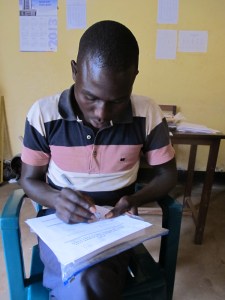
So Denis had every right to be nervous and as he pulled the boda onto the school compound, he was quiet.  I had my camera at the ready, knowing that he might be too nervous to remember the details of the day, but that it was a day so worthy of remembering.  We entered the modest handmade brick building that serves as the office.  The administrator was working inside and she welcomed us as we entered.  We sat in front of her desk and to my surprise, Denis asked her none of the questions he’d mentioned to me on the boda.  He sat quietly in the chair and twisted his hands, fidgeting and barely making eye contact.  I began to ask questions on his behalf, voicing all the things he’d wondered aloud on our daily rides.  The administrator gave Denis the registration form and he fumbled with it, his hands visibly shaking.

“Denis, relax.  This is a good thing.  You get to go back to school,” I covered his hands with my own.  “Just relax.  Why don’t you fill out the form while we’re here and if you want me to look it over, I’m happy to do that.”

“Yes.  I’ll fill it out right now,” Denis removed a pen from his pocket.  I watched as he wrote every word and letter with precise care.  I talked to the administrator while Denis filled the form out and I was delighted to find out that the administrator was once a primary teacher.  I shared with her that I’m a primary teacher in the U.S. and we had a lovely chat.

“Alicia, will you take a look?”  Denis passed me his registration form.  I scanned the facts of his life.  His age.  His family name.  His tribe.  His birthdate.  The name of his last school.  So much information about my friend and at the same time so very little.

“Looks good, Denis, but you have to fill out the back as well,” I said quietly turning the paper over and passing it back to him.

“The back?”  If it were physically possible, I think Denis would’ve blushed.  He took the paper and read the backside, carefully filling in more spaces.

“Are you his sponsor?” the administrator asked me.

“No, I’m his friend.”

“His friend?”

“Yes, he’s my boda driver and we’ve become friends.”  I smiled at Denis and snapped his photo as he filled out the registration paper.

“Can I put your name here?”  Denis pointed to a place on the form for names of people likely to visit him at school.  He’d listed his mother and one of his brothers.  There was one more line.

“Definitely.  I’d love to visit you at school when I return.”  Denis wrote my name.  The form also asked for the relationship.  Denis penned the words ‘best friend’.  I smiled knowing I was in good company with his best friend J.B. and his other best friend, my oldest son, William.

IMG_0410Denis completed the form and we left the school under a drizzling sky that couldn’t begin to dampen my mood.  I snapped a final photo of Denis standing outside the doorway, his school name emblazoned above the door.

A couple of days later he returned to school with the requisite passport sized photo and his enrollment fee, courtesy of my beloved Oregon Vigilantes.

In one of our many conversations, Denis asked if I would return to Uganda for his graduation.  “You will sit next to my mom and wear a Gomesi.”

“I’d like that.”

“To wear a Gomesi?”

“To see you graduate.”

On my last evening in Uganda, I sat in a hotel room near the airport and all the way across the country from my loved ones in Gulu.  My phone rang and on the other end was Denis calling to tell me he’d used some of the money from the Oregon Vigilantes to sign up for additional tutoring before the term started and also to buy books and a school uniform, the requisite attire for all schools in Uganda.

The new term begins in a matter of days and after years of waiting and working and praying and hoping for a second chance to go to school, my dear friend Denis is a student once again.  And it’s all because some recklessly kind Oregon Vigilantes saw Denis’ potential from halfway around the world and decided to do something about it.

Vigilante Kindness: A Gift From Oregon, Part 1

“They came back to Bungatira after I took you home,” Denis sits across the cafe table from me with his hands folded.

“They did?”  Nerves bounce in my stomach and I think a familiar mantra. Walk into the conflict.  “Denis, I really didn’t mean to offend anyone.  In my spirit, I couldn’t agree with your original Constitution.  I just couldn’t.”

“I know and I’m sorry for causing you pain,” Denis apologizes for what is the fourth or fifth time and he is so sincere that I have to look away before my tears spill over.  “But they came back to assure me that they really will change, that we will accept people with mental sicknesses.  We will change.  I promise.”

“They really walked back to Bungatira in the dark to tell you that?” I’m incredulous.

“Yes.  And I promise we will change,” Denis holds my gaze.

“I believe you.  It’s actually why I wanted to meet with you today.  I have good news for you and for Bungatira.”

“I already have pigs.  What other good news could there be?” he laughs.

“You know how my friends and family have been sending money for me to do kind things here?”

“Yes,” Denis nods.  He knows better than anyone because he’s helped me haul pigs and shoes and mattresses and medicine and a wild assortment of other things.

“This is my friend Jenna,” I show Denis a photo of her on my iPad.  “Jenna and her friends in Oregon sent over a large sum of money, so large that Jenna and I weren’t exactly sure what to do with it.  So we’ve been praying about how to best use this money.  You know that some of my loved ones have mental illnesses, but what you don’t know is that Jenna’s son, who was a soldier in Afghanistan, has returned home from war and has also been struggling with post traumatic stress.  Here he is with his newborn son,” I flick to a new photo on the iPad.

“I’m sorry,” Denis’ forehead is creased with worry.

“Jenna tells me that fatherhood is helping him return to himself, helping him remember who he’s called to be.  Denis, I wrote about my difficult day in Bungatira and when Jenna read that you’d changed your Constitution to include people with mental illnesses, she immediately messaged me to give the money to you and to Bungatira.  Jenna and her friends are giving you this money so that you don’t have to wait for your pigs to mature in order to return to school.”

I open my travel notebook to the page where I’ve scrawled 250,000 shillings, the equivalent of $100.  It’s enough to pay for schooling for the upcoming trimester as well as part of the next trimester.  On a good day driving his boda Denis makes approximately $6, not enough to live off, let alone pay for school.  I take the shillings out of my purse and slide them across the table to him.  He counts them in disbelief.

“Thank you, Alicia.  This is all because of you.”  Denis comes around to my side of the table to hug me.

“Denis, I need you to hear me when I say this.  It’s not because of me.  It’s because of the changes you and the group in Bungatira are making.  You’ve inspired Jenna to support what you’re doing here.  It’s because of you, not me.  I’m just the one who gets to deliver the message.”

“Now you listen to me, Alicia,” Denis jokingly wags his finger at me.  “You’re delivering the message and your message is hope.” By this time, tears are welling in Denis’ eyes and flat out dripping down my own cheeks.  He continues.  “My family told me to go to a trade school to become a boda mechanic, but I kept telling them that I wanted to go back to school and get my degree, that I want to me more than a mechanic.”

“And now you can.  Denis, you get to go back to school.”  We’re both smiling and blinking back tears.  “You get to be a student again.”

“Will you go with me to register for school?” Denis grins from ear to ear and I do, too.  He’s 27 and he’ll be returning to what is the equivalent of third trimester of his sophomore year in high school.

“It will be my pleasure.” I use a napkin to wipe my eyes.

“I might become a doctor instead of a teacher,” Denis dreams out loud.

“I think that would be great.  Doctors are teachers, too, you know.”  We sit for a moment with that dream between us on the table.  “But wait, Denis, I have more good news.  Jenna and her friends sent money for Bungatira so your group could start up the savings and loan program you’ve been talking about.  People in Bungatira will be able to take out loans to send their kids to school.  Here’s how much Jenna and her friends want to give your community group.  I slide the notebook over again and point at the number I’ve written.  640,000 shillings, approximately $250 dollars.

Denis is out of his chair again and we’re hugging and laughing and crying and making a complete scene in the cafe.

“I know my last visit to Bungatira wasn’t easy for, well, anyone, but I’d like to return and tell the group about Jenna and her son and tell them that the changes they’re making are inspiring people halfway across the world.  The other thing I’d like to do is return next year and see all the good Bungatira is doing with the money.  Is that okay?”  I’m hesitant about asking to return.

“Of course, it’s okay.  You’re ever welcome in Bungatira,” Denis smiles and then pauses.  “Alicia, where are you from?”

“Denis, you know I’m from California,” I laugh because this is a fact he’s known for over a year.

“No, I mean where did you come from?”

“Sorry, I don’t understand the question.”  I’m lost in translation a LOT in Uganda.

“I mean, I don’t think you were born.  I think you were sent.”

“What?  Denis, trust me, I was born.  I weighed nine pounds, one ounce.  I was definitely born.  Just ask my mom.”

“Alicia, trust me, your mom would say you were sent.”

“Denis, you give me too much credit.  This is because of you, not because of me.”

“And you don’t give yourself enough credit, Hero Lanyero.”

I blush at my name, one I’ll forever try to live up to.  I quickly change the subject.  “You’ll talk with the group in Bungatira and let me know when I can return and present the money to them?”

“Yes, we’ll go on Sunday.  I’ll ask the local dance group to come and perform traditional dances as well.”

“I’d like that.  I haven’t seen any traditional dances yet.”

“And tomorrow we’ll go to my school so I can register.”

“I’d like that even more.”  My cheeks ache from smiling, but I can’t help smiling at my friend who gets to go back to school. I can’t help but smile for my sweet friend, Jenna, and her fellow Vigilantes of Kindness who have made this possible.

Denis leaves me alone in the cafe and I sit thinking about how blessed I am to return to this land and to this people I love so dearly.  My mom can verify that all nine pounds, one ounce of me was born in California, but sitting in my favorite cafe in Gulu, I know with every beat of my heart that this-this beautiful work of being kind for the sake of kindness-this is why I was born.