Chickens: A New Year’s Resolution

It’s no secret that I hate birds.  I’m talking the fire of a thousand suns kind of hatred.  Just in case you’re thinking my bird loathing isn’t justified, let me send you on a little trip down memory lane to the day a wild turkey chased me to school.

Go ahead, I’ll wait.

See?  I hate birds and they hate me. Fair is fair.

Last summer, with just a few days remaining in Uganda, my three boys set an official meeting with me.  They’d been having “brothers only, no mother” meetings without me for a few days, so when they set this meeting with me my interest was piqued, to say the least.

I’m new to this parenting thing and I was a little nervous.  They’re not biological brothers.  Being brothers is as unfamiliar to them as motherhood is to me.  We’re all still working out the kinks of our unlikely family.
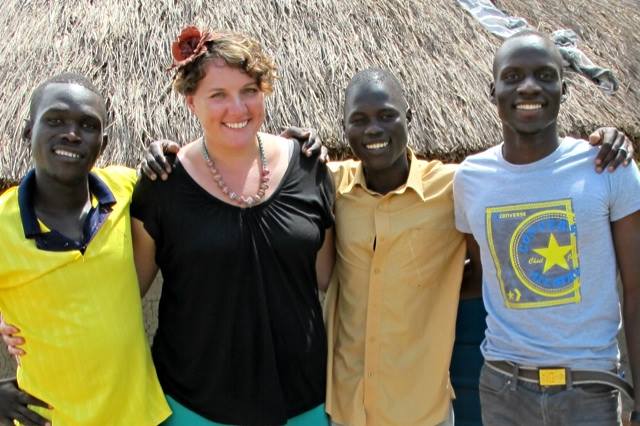
Lanyero and Sons: Otim Geoffrey, Alicia, Oryem William and Opiyo Martin

The day came for our meeting and we sat outside at a table, drinking pineapple Merinda.  My boys began to speak.  They told me how grateful they are that Terry and I support their schooling and how grateful they are that we do so much for them.  They also told me how difficult it is for them to ask for our help, especially because they know we’re supporting all three of them.

I didn’t have much of a response except to say that I understand how difficult it is to ask for help.  Most days, I’d rather die than admit I need help.

I also told my boys that as their mom, part of my job is to say no when they ask me for things that aren’t in their best interests.  (Right moms?  That’s part of the job, right?  Oh, I’m so new to this.)

They continued, telling me that they’d developed a business plan so that they could begin to pay their own school fees and pay for other necessary items like books, food and clothing.

I took a deep breath.  Young boys with a business plan sounded like bad news to me.  I had “No” ready on my lips.

Then they pulled out photocopies of their business plan and I knew they were serious.  Typing up the plan on a computer and then making copies isn’t that easy when you don’t have access to things like a computer, a copier or regular electricity.

Martin, my middle kid who named me Lanyero, went over their plan in detail and I couldn’t help but giggle.

My boys had created a beautiful business plan to start a chicken farm.

A chicken farm, proof positive that God has a wicked sense of humor.

They even named it: Lanyero and Sons Broilers.

Lanyero means “joyful”.  The literal translation means “laughter”.  And, Lord have mercy, did I cackle at the thought of starting a chicken farm in Northern Uganda.

What brings me joy about their plan is that they want to tithe a portion of their chickens and eggs to local organizations that take care of people with disabilities, widows, and orphaned babies and children.

My formerly orphaned boys want to help care for orphans.

And just like that my heart melted.

So as people around me are making New Year’s resolutions to get healthy, get organized, get out of debt, I-the girl who is petrified of all things feathered-am making plans to get chickens.

Wanna help make the chicken farm come to fruition?  Here's your chance.  

Love Has Come

I ugly cried in church last Sunday.

I’m not a big crier.  Crying in front of someone or worse yet, lots of someones, is my #1 Top Most Embarrassing Thing Ever.

And yet there I was absolutely weeping.  Mascara dripping, nose running, shoulder shaking, flat-out sobbing.  I blame Jeremy Riddle and his song God of the Redeemed.  Go ahead, take a listen.

http://www.youtube.com/watch?v=7E6DnQUcmpM

I didn’t even make it through the first verse.  “Love has come.  We’re orphans no longer.”  At that point it was all over.  I didn’t have time to swallow the lump rising in my throat before the tears started streaming.

By the time it got to, “Hallelujah, to You, the God of the redeemed,” I was a complete wreck.  All I could do was stand there, lift my face and cry.  The tears dripped down my cheeks and into my ears, so many tears that my ears filled up and overflowed down my neck.

I cried in joy because I’ll see my boys and all my other Ugandan kids in a few short days.

I cried for my boys who were orphans.

I cried because I’m overcome that they’ve chosen me as their mother.

I cried for my son who used to think he was nothing.

I cried out of gratitude for a school that in tangible ways shows my boys they’re worthy of redemption.

I cried the tears of a thousand hallelujahs.

And when I ran out of tears, I stood in silence doing nothing, not singing a word, barely uttering even a breath.  And in my quiet, in my stark nothingness, I stood and didn’t care how many people saw me cry.  In that moment everything else ceased to matter.

I’d been looking for a gift to give my boys, something to remind them that they’re not orphans anymore, that we have claimed each other as mother and sons.  I looked and looked, but nothing was right.  And then I saw them.

love rings

Simple rings, one for me and three for them, reminders that love has come and that the best love often comes in unexpected ways.  Meeting the love of my life when I was fifteen and filthy dirty from helping build a church in Mexico.  Finding my sons 9,049 miles away.  The baby in a manger who redeemed us all.

Love has come and it leaves me in such awe that it’s all I can do to whisper hallelujah.

Lanyero Mama

“Mum, ask me a question.”  Martin doodles on his notebook.  We are seated side by side, so close that our hips touch.

“Let me think of one.”

“You always ask me challenging questions that make me think.”  He smiles at me, pausing in his drawing.

“I’m sorry, son, I can’t think of one today.  My brain is too sad to think of a question.”

“My brain is sad, too, Mum.”

“I’m going to miss you.”

“Me, too, but African men don’t cry.  When we’re sad we just feel out of place.”

“That makes sense to me.  I feel out of place, but I’ll probably cry a little tomorrow.”

“Don’t cry, Mum.”

“I might.  But I did think of a question.”

“What is it?”

“My question is ‘What have you been thinking about today?’.”

“What have you been thinking about today?”  Martin bats the question back to me with a familiar twinkle in his eye.

“I asked you first.  So you have to answer first.”  I nudge him with my elbow.

“Give me another question.”

“Okay, how about this.  My boda driver asked me if any of the students had given me an Acholi name yet.  I told him no.  He said I should be named Aber Alicia because ‘aber’ means good and he says I’m good to everyone.  Do you think that’s a good name for me?”

“No, it’s no good.  Your name is Lanyero.  Lanyero Alicia is what you should be called.”

“What does it mean?”

“Lanyero means laughter, joyous, happy.  It also means comforter.”  He meets my eyes and mine well up with tears.  He looks down at his sketches.

“I love it.  Did you know that Alicia means ‘truthful one’?”

“No, I didn’t know it.”

“So Lanyero Alicia means ‘one who takes joy in telling the truth’.”

“Mum, I’m really going to miss you.”

“Me, too.  I feel like my heart is in my throat.”

Martin shoots me a puzzled look.

“That means I’m really sad.  I’m having a hard time swallowing my sadness back down.”

“You’ve taught me something new, Mum.  My heart is on my throat, too.”

I feel a smile slip through my lips as I picture his heart on his throat.

“You can cry if you want to, Mum.  African women cry very loudly.”

“I’m not African, Martin.”

“Yes, you are.  I just named you so.  Lanyero Alicia.  But I won’t call you that.”

“You won’t? Why not?”

“I’ll call you Lanyero Mama.”

“That’s my favorite name.”  I put my arm around him and squeeze this boy who named me, this son who has claimed me as his unlikely mother.

Martin & I

Geoffrey’s Ear

“He’s the one who cut my ear.”  Geoffrey looks at the ground and twists a piece of grass between his fingers.  It surprises me how in this moment, nineteen year-old Geoffrey reminds me of a little boy.

“Do you want to tell me more about that?”  Up until that point my questions about his story for our book were benign.  How old are you?  How long did you live with your grandmother?

I’d known Geoffrey for going on 2 weeks, and I’d come to love this orphaned boy.  He is sweet in unexpected moments, mischievous in others and I love both sides of him.

I’d noticed his ear on my first day at the academy, when he saw me with a camera and asked if I’d show him how to use it.  I didn’t ask him about his ear, figuring he’d tell me if and when he was ready.

Photo courtesy of Colin Higbee

What I didn’t know is that when he was ready, he’d tell me a story for which I’d never be ready.

Geoffrey’s parents died when he was a young child.  His father died at the hands of a LRA soldier and his mother died shortly thereafter of an illness.  After their deaths Geoffrey lived with his grandmother, but unfortunately her hut was located in an area that was soon infested with LRA soldiers set on kidnapping children to turn into child soldiers.  To protect fourteen year-old Geoffrey, his grandmother sent him to live with his uncle.

Geoffrey’s father was a rough man; prone to acts of abuse inflicted on his children and even his younger brother, the uncle Geoffrey came to live with.

“Why would he cut your ear?  I don’t understand.”  I stammer.

“He was taking revenge on my late father.”  Geoffrey meets my eyes and I blink back tears.

“I still don’t understand.  Why would he cut your ear?  How is that revenge on your father?”  I probe further.

“I went to church in Gulu to pray and my uncle, who didn’t believe in God told me not to pray.  When he found out I’d gone to church to pray, he told me ‘You never listen!’ and then he flashed a knife and cut off part of my ear.”

I will the hot vomit rising in my throat back down into my stomach where it gurgles and boils.

“Did you go to the hospital?”  I gulp for air, trying to give him the space to continue if he so chooses.

“I walked to the clinic.”

“Did you continue living with your uncle after that?”

“No.”  He shook his head.

“Where did you live?”

“On the streets.”

“For how long?”

“Two years.  Then my cousin’s sister found me and I lived with her for a little while and then more on the streets.  Now I live here.”  He looks around at the academy.  “I have my own place in town.”

“How do you pay for your own place?”

“During holidays I work here at the academy doing construction and I save that money so I can have a place to live.”

He keeps talking and I look at his ear until white-hot fury blinds me and I have to blink it away.

It is enough to be orphaned.

It is enough to leave your home to avoid becoming a child guerilla.

It is too much to suffer violence inflicted by the very family meant to protect you.

It’s too much.

On the inside I am choking on my anger, willing myself to remain calm while he unpacks the rest of his story.

Geoffrey continues, telling me about school and about the American family-his family– who helps pay for his school fees.  He tells me about his future plans to open up an orphanage to care for lost children and my heart swells with pride for this boy.  My fingers can barely keep up with him as I take down his words.

The day I showed Geoffrey how to use my camera, he took off with it for a couple of hours, snapping photos all around the school.  That night back in town, I looked at the images he’d captured.  I was taken aback by some of his shots.  He has a natural way of seeing people and capturing light.  I suspect this comes from watching people from the outside.

I suspect that as he grows into a man, Geoffrey will always have an eye for seeing people.  I also have a feeling that throughout his life he will hear the voice of God speaking clearly, whispering into his severed ear that he is loved, he belongs and that he is in fact a valued part of a big family.

“We need to work on your title a little bit, Geoffrey, to make it match your story.”  We toss ideas back and forth for a few minutes and then Geoffrey smiles.

“I know what to call it.”  Geoffrey grins from ear to ear.

“Tell me.”  My fingers hover over my keyboard.

“I want to call it ‘Finding Family’.”

My First Ugandan Son

Before leaving home for Uganda, I promised Terry I wouldn’t return with an orphaned baby.  Frankly, the motherhood gene skipped me completely so it was an easy promise to make.

Until I met Opiyo Martin.  I call him Martin for short, but nine times out of ten, I call him son.

He’s a smart boy, loving and warm.  Oh, and he’s 19 years old-way past the drooling baby stage.  Thank God.

photo courtesy of Colin Higbee

One day I was hen-pecking Martin about something, like taking time to eat or straightening his tie, and in his best teenage boy voice he replied, “Okay, Mum.”  “You’re a good son, Martin.” I smiled.  And that was it, I was a goner.

As so many unexpectedly sweet things do, it felt natural and right, like I’d been calling him son all his life, like this child was born out of my heart, if not my womb.

He greets me every morning with a “Hi, Mum.” and a hug.  He finds me during lunch time to make sure I have food, often times offering me his food if I have yet to get mine.  This act may not sound like a big deal, but if Martin gave me his food, it would mean he wouldn’t eat lunch that day.  And yet he offers, knowing full well that his offer comes with sacrifice.  At the end of the day if Martin knows I’m leaving, I get another hug and an escort to the gate.

Martin devours literature.  He sings all of the time and I can’t help but giggle when he sings the wrong words, kind of like someone else I know.  Ahem.  He writes songs, raps, poetry and anything else he can think to scrawl on a piece of paper.  He wants to be a writer or a pastor when he grows up.

He is so obviously my son.

Martin has his own family here in Uganda.  Two of his younger cousins attend the academy with him.  His uncle teaches literature.  He has an older sister who is already married and a nine-year old brother still in primary school.  As with so many students here, he is impoverished of his parents, but rich in non-traditional family members and I’m blessed to be folded into his family.

Today I had the pleasure of working one on one with Martin on the story he’s penning for our book.  Earlier in the week, Martin mentioned that he wanted my help in writing, so when it came time for us to work, I didn’t hold back.  I asked question after question about details he’d left unanswered.  He answered each one, painting in gritty details that cut to the heart of who he is.

In the face of evil that threatened to end his life, Martin, my beautiful son, chose to forgive.  Typing that word ‘forgive’, it’s the only time I’ve ever felt the word doesn’t adequately describe the depth of forgiveness.  Martin didn’t just forgive, but he forgave with utter absolution that I can only begin to fathom.

I’m not writing his story here for many reasons, but the chief reason is that his story pierces such a raw place in my spirit that I physically cannot type it through my tears.  I’m profoundly proud of him, proud to know him, proud to be called Mum, proud to call him son.

In this surprising and wonderful mother-son relationship, I’m teaching my son to write with heart while he teaches me to live with heart.