We’re a rag-tag group of people vigilantly pursuing self-sustaining educational & employment opportunities with and for students and their families living in rural communities in developing countries. We believe in asking hard questions like, “What do you need and how can we help?” We believe that communities know their needs better than we do and that it’s our job to listen. We’re big on being kind for the sake of kindness and we believe that even the smallest acts of kindness can make a big difference. We believe in keeping vigil over one another and watching for opportunities to help, no matter how far off the beaten path those opportunities take us. We’re vigilant in our belief that God has given each person unique gifts and that one of the highest forms of worship is using those gifts to serve others. We believe God has a purpose for each life and Vigilante Kindness is our purpose. Join us as we live out wild adventures in service of God and others. Join us in committing acts of Vigilante Kindness.
This year I was present for Election Day at school. There was a page worth of candidates on the ballot running for different student offices. Each candidate had a couple of minutes to deliver their campaign speech to the 300 members of the student body. Before the speeches began, one of the English teachers stood and spoke about the procedures. He encouraged the students to listen carefully and then to vote with their hearts.
The speeches began and during the speeches the students were asked to submit their questions to the student Parliament running the proceedings. There were many coveted offices like Head Boy and Head Girl, each in charge of overseeing their assigned gender and assisting with any problems they’re having which they may not feel comfortable immediately bringing to the adults. One of the most coveted offices is that of Time Keeper. Time Keeper rings the bell to indicate that class sessions are over, that lunch is over, that the school day is concluding, that church is beginning. It is a big responsibility and not one to be taken lightly.
There were several candidates for Time Keeper and each gave an excellent speech, but there was one who stood out to me above the rest. Crispus is an S1 (8th grade), student. He’s a tiny kid, about as big as an American third or fourth grader. What he lacks in stature, he makes up for in personality.
When Crispus began his speech, I actually jumped at the sound of his voice, so loud and full of enthusiasm. He proclaimed that he is responsible and owns a good watch which would allow him to ensure that classes ended and lunch began on time. The crowd, which had been boisterous throughout the whole assembly now became more vocal than ever.
“He’s too young!”
“This is too much responsibility.”
“He’s only an S1.”
Tiny Crispus stood, shoulders back, taking it all and never responding in turn, waiting for the student Parliament to gather questions from the audience and read them to him to answer.
The heckling continued until suddenly the audience began to turn in his favor. Those who had opposed Crispus could be heard no longer over the din that arose. First there was clapping, followed by stomping of feet and then a roar erupted from the crowd. They shouted his name and cheered for him.
So loud was their cheering that the student Parliament couldn’t contain them and Crispus couldn’t contain his grin, which had spread from one side of his face to the other. After returning to his seat, Crispus continued to smile for the rest of the proceedings. I imagine he went to bed smiling.
“Peter Paul Opok Road. That’s where the gallery moved to.”
“I do not know that road.”
“A road you don’t know? I never thought that would happen.” I poke Denis in the back.
“I will find out. We will go.” Denis speaks to some men building bed frames by the just moved sign hanging by the old studio/gallery. He returns a minute later. “Okay, I know.”
We speed to the back side of town, curling in between traffic and pedestrians along the muddy road. I’m going to miss riding on the back of motorcycles. I tip my face to the sky and let the sprinkling rain hit my cheeks.
My favorite artist, Omuny, is in residence and she has new pieces hanging all over the walls. She’s been busy since last summer. Behind the counter is a stack of paintings leaning against the wall.
“Are those for sale?”
“Yes. I just haven’t put them out yet.” Omuny motions me behind the counter and I flip thorough the stack.
The moment I see it, I know it’s the one for my artist sister. Supporting a local artist is the perfect way to spend the rest of her Vigilante donation.
“I’ll take this one, please.” I hand it to Omuny who removes it from the frame and rolls it for me.
I carefully count out bills and I squeeze them tight in my hand. She hands me the painting and I shove the wad of bills in her hand, practically running out the door. I grab Denis’ sleeve and pull him out with me. “Quickly, quickly let’s go!” I can barely control my giggles.
We speed away and from the back of the boda I see Omuny hurrying out the door toward us.
“How much did you pay for that?” Denis calls back to me.
“Enough.”
“Did you barter with her?” Denis wrinkles his brow.
“Nope.”
“Did you pay the asking price?”
“It’s so much worse than you think.” I turn and wave at Omuny. She waves back and smiles.
“Tell me.” Denis is stern now.
“I paid her double!”
“You’re doing things all wrong.” He shakes his head at me, like he so often does.
“I know.” I can’t suppress my grin.
Back in my hotel room I unroll the painting. I take a snap and giggle at the thought of Omuny counting out the money and finding I’d paid double the asking price. I AM doing things all wrong this trip and my heart feels so completely right.
If you’re just joining the story of Shiny New Shoes, you can read Part 1 here.
Denis hoisted the sack of shoes onto the front of the boda. Monday morning had arrived and that meant it was time to pass out shiny new shoes to the P1 students and to the children living on campus. Although the road was clear and Denis zipped along, the ride to school seemed interminably long.
Finally we reached the campus and Denis hefted the sack off the boda. I enlisted the help of my son, Geoffrey, and two of my young writers from last year, Richard and Johnson. Together we lined the shoes up on the step outside of the classroom, each pair with a child’s name carefully penned of the tag. 27 pairs in all.
Half an hour before school was finished Mr. Martin brought the class outside and I called out the name of each and handed them their shoes, Mr. Martin and my three older student helpers stood ready to help tie all those shoes.
When I handed each student their shoes and a bright white pair of socks, they were too surprised to speak. The took the shoes and then in a bit of a daze, they got help putting them on. I’ve seen this dazed look before on my own first grade students when we went on field trips that were so amazing that all they could do was stand there and take it in.
One little one said, “Thank you” as I handed her a pair of shoes and the rest of the children remembered their manners and followed suit, thanking me in their best English.
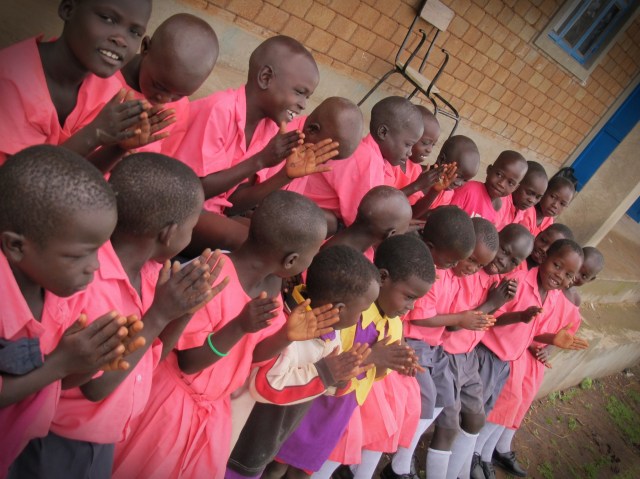
When everyone had been given their new shoes, it was time for pictures. Some of the kids grinned so widely that I was sure I could see every single tooth. Others were still dazed. They sang their goodbye song and I recorded a bit of it to show the donors and then clapped to show their appreciation.
When Mr. Martin dismissed them to go inside and stack their chairs and go home, they stomped up the stairs, giggling at the sound of their new shoes on the pavement. I laughed as they stomped up a storm and when they came back outside, every single child stopped to shake my hand and say thank you.
As they walked off campus, I watched them carefully avoiding mud puddles to keep their shoes shiny and clean. One little girl stopped every few feet to dust off any specks of dirt that got on her shoes. I can only imagine how long it took her to walk home that day!
Another little girl could not wear her new shoes that day. In all my days on campus, I’d never seen her wear shoes. She had a wound on her foot from walking everywhere without shoes. She is the reason this Vigilante Act of Kindness was so needed. She’s the reason why I’m so appreciative of all the Vigilantes who made this shoe project possible. I watched this little girl walk home, cradling her new shoes carefully in her arms. I saw her again two days later wearing her new shoes, protecting her precious feet, and couldn’t help but smile in gratitude for my friends and family who had offered of themselves to provide her with shiny new shoes.
There is a musee (an elder) who stands guard at the front of the school. His English is as good as my Acholi, a fact that we laugh about daily. When Denis picked me up from school that day, the musee stopped me. He shook my hand and in words I think he’d been practicing all day, he said, “Well done, Madame. Well done.” So to my fellow Vigilantes of Kindness, I pass along his words and with a full heart I say to you, “Well done, friends. Well done.”
My tiny hotel room smelled like bananas. The two clusters of bananas I’d bought were fresh from the tree and their smell permeated my living space.
The morning of Visitation Day at the school had arrived. Parents would arrive to visit their children and to talk with the teachers about their child’s progress. For most it would be a happy day.
For the orphaned students it would be one of the most difficult days of the year.
The school had been buzzing about Visitation Day for weeks, but underneath the excitement I heard quieter voices, one in particular belonging to Ivy.
“Ivy, are you excited for Visitation Day?” I asked.
“Sure,” she shrugged the word out of her mouth.
“Is your family coming to visit you?”
“No, my parents died when I was a baby and my aunt is paralyzed and lives too far away to travel.”
“I’m coming to Visitation Day to visit my sons. Maybe I could visit you, too?” I suggested.
“I’d like that,” she smiled and looked down. “Alicia, lots of kids here call you Mum. I know you have three sons. Could I call myself your daughter?” Ivy avoided eye contact.
I was taken aback by her request, but when I saw her downcast face, the only appropriate response was, “I’d like that, Ivy.”
“Good. Then when the other kids ask who is coming to visit me on VD, I can say my Mum is coming to visit,” she smiled at me from behind her glasses.
I picked my heart up off the ground and wondered how many other orphaned kids were wanting to, but couldn’t say their mom was coming to visit.
Word spread around the school that I’d be visiting kids that day and soon the list of kids claiming me as their visitor grew quite long. I asked around about exactly what it is parents do on Visitation Day. In addition to visiting their children, and speaking with the teachers, parents bring them special foods from home.
I had the visiting thing under control, but I didn’t have the skills or the kitchen to prepare any special foods from home. So I called in help. The day before Visitation Day, I had a meeting with Joseph, the fledgling chef who works at the hotel where I’m staying. Joseph is twenty-one years old and is trying desperately to earn enough money to finish his final year of culinary school.
“Joseph, tomorrow is Visitation Day at my school and I’m going to have a big picnic. Where could I get a ton of chipatti and a fresh order of bananas, too?” I sat across the table from him, drinking mango juice he’d squeezed that morning.
“Give me the contract and I’ll have everything perfect for you tomorrow morning,” Joseph replied.
We agreed on an amount and I gave him some Vigilante shillings. We shook hands and the evening before Visitation Day, two clusters of fresh bananas were placed in my room and the morning of Visitation Day, the chipatti was perfect, just as Joseph promised. I already had a jar of fresh groundnut paste (like peanut butter, only better) that would round out the meal.
I’d planned on looking my best for Visitation Day, wearing my cleanest hand-washed clothes, shaving the layers of dirt off my legs and washing my hair, no matter how frigid the water was. I woke up that morning and didn’t hear the familiar rumbling sound of the back up generator. Oh, good, there’s electricity today. I flipped the light switch. Nothing happened. Oh well, no electricity today. In the bathroom I turned the hot and cold water knobs. Again nothing happened. I guess I don’t have to worry about cold water or any water for that matter. I put my relatively clean clothes on my relatively dirty body, brushed my teeth with my one remaining bottle of water and clamped a headband on top of my out of control curls. I looked in the mirror. It would have to do for the day.
It rained the entire morning and I sat by the window in my room willing the rain to stop. Instead it poured harder. The streets were devoid of sputtering bodas. When the rain slowed to a drizzle, I packed the bananas, chipatti and groundnut paste into my backpack and called my faithful boda driver, Denis. Juba Road was a slick mess of red mud. Mud flicked off the back wheel and splattered my skirt, but I was sure a little water would take care of the mud splatters. That thought was still hanging in the air like a bubble over my head when a truck came barreling down the road from the opposite direction. It raced through a puddle and splashed muddy water all over Denis and I. I was soaked to the bone and at that point all I could do was laugh at the muddy mess I had become.
The drizzle continued all the way to the school and kept parents at bay. The school was quiet and subdued, the gray skies matching the mood. The parents would have to come on foot or by bicycle, so rain was a legitimate, but still disappointing reason for their absence.
When I arrived at school, I pumped water to wash my face and skirt, but the mud was so caked to my skirt that adding water became a recipe for an even bigger mess. So I planted my mud caked self under the covering of the open classroom and waited to visit with students. A few scuttled here and there in the rain, bundled up in layers of jackets in the 70 degree weather. As the students hurried by, I called out, “Happy visitation day! Come and visit with me!” Almost every student I invited took me up on my offer and pretty soon I had a cluster of kids around me, some who were on my list to visit and other new additions. My two youngest sons were at the center of it all and they were in fine form hamming it up.
One of my favorite boys, a sweet orphaned boy, said, “I didn’t think you would come because of the rain.”
“I promised you I’d come. It’s my first Visitation Day. I’d planned to look a little more presentable, but that didn’t work out so well for me.” We both laughed at my mud stained clothes.
“It’s okay, Mum. I’m glad you showed up.”
We were having a great time and before we knew it, it was lunch time and so we retreated into a classroom where anyone and everyone was welcome to the feast I’d carried in my backpack. When I unpacked it, one of the boys remarked, “You brought us food just like the mothers do on VD!” They devoured the food like a band of locusts. I must admit my eyes welled up when every single child made sure to thank me afterward.
While we were inside eating, the rain stopped, the clouds parted and the sun came out. Mothers and fathers began to arrive. The mothers were dressed in beautiful clothes and carried baskets of handmade and homegrown food. Not a single one had a splatter of mud on their skirt. They were a parade of beauty and poise and I was a stark contrast.
I continued visiting with students all day, making sure to carve out special one on one time for my sons. It was a beautiful day.
As evening approached, or as they say here, as the sun married the moon, I returned to my hotel where I washed the slicks of mud off my skirt and scrubbed my skin clean with mercifully hot water. Under the tent of my mosquito net, I thought about how it didn’t matter at all that I arrived wet and muddy. What mattered was that I showed up.
Though I searched and searched for her, I never did see Ivy that day. She later told me that she was feeling ill and had slept all day in the dorm. I wonder if the words felt as untrue in her mouth as they sounded in my ears. Many of the orphans feign illness and sleep the day away until it passes. When I told Ivy that I’d missed visiting her, she peered up at me through her glasses and said quietly, “You came for me?” I nodded and she said, “I didn’t think you would. Thanks, Mum.”
The new school year is fast approaching and I know I’m going to have students who are used to being let down by parents who don’t show up. On mornings when I feel caked in frustration with administration, when I feel like I’ve been splattered with parent complaints, when I feel soaked to the bone with exhaustion, I’m going to remember Visitation Day and I’m going to show up. I’m going to show up and have faith that the clouds will part and make way for something beautiful. I’m going to show up and show up and show up, especially for my kids who are hiding out and tucking their hearts safely away. I’m going to show up hoping that when I do, it will give them the courage to do the same.
A friend once advised me that when I find myself in opposition with another, I should “walk into the conflict”, meaning move in closer so that resolution or at least common ground can be found.
It’s a difficult task for me because, well because I’m a giant chicken and my natural inclination is to retreat. It’s even more difficult for me walk into the conflict when I don’t see it coming and then suddenly find myself face to face with it.
Sunday was one of those days.
Bungatira, a village outside of Gulu, is home to Denis, his family and some mighty cute piglets. I was delighted to be invited back along with my son William, and my two new Swedish teacher friends, Annika and Jessica. It was a beautiful day and with a view of the lush green valley that seems to stretch for miles, the ride there didn’t disappoint.
When we arrived in Bungatira we were greeted with a welcome song and dance from Denis’ mother and the ladies of the community. It was lovely.
Bungatira has a local community group, of which Denis is the chairperson. The group is working together to make their community a better place. They’re doing it independently of NGO’s that seem to have set up camp on every corner in Uganda. They’re doing it without government aid. It’s a grass-roots group focused on improving their future.
This group is doing so many great things and I love that all of their ideas are purposes are from within. They’re beginning a savings and loan program for members. They’re looking for ways to fundraise to pay school fees for their children. They’re seeking education on issues like health and cleanliness and domestic violence. They have an eleven article constitution that details the rights and duties of membership. They have democratic elections each year. Membership is open to both male and female residents who are at least twelve years of age. The group in Bungatira is doing so many progressive things, especially when compared with surrounding villages. So when Denis asked if I’d sit in on their meeting and offer them advice if I had any, I was honored. In the back of my mind, I hoped to find another place to exercise some Vigilante Kindness.
After taking a tour of their village and having lunch in Denis’ thatch roof house, Annika, Jessica, William and I joined the meeting in progress outside. I sat down on a mat next to Denis’ mother. The group was discussing the savings and loan idea. I listened in and strained to translate Acholi into English. William joined the meeting as well and sat a few yards away from me, translating when I requested clarification. Annika was feeling ill and so Denis took Jessica and Annika back to their hotel on his boda. The meeting continued in his absence and moved on to elections. Denis was nominated for re-election and I was pleased to see that the nominations for other offices were split between men and women.
The Vice-Chairperson turned his attention to me and asked that I speak well of their group when I returned home. I asked to first read their constitution, which was written in English. The constitution was meticulously written in ink on lined paper, something that is quite costly and not easy to find.
They’d obviously put a lot of thought into it and I agreed with all of it-except their policy for dismissal from the group. Reasons for dismissal from the group were:
voluntarily leaving the group
death
failure to pay membership dues without reasonable cause
mental illness
Wait, what? Mental illness was an automatic reason for dismissal?
I felt like I was having one of those moments in the movies when the people are happy and there’s upbeat music playing and then everything halts as the music comes to an abrupt needle-scratching-across-the-record-stop.
After I read the Constitution, the Vice-Chairperson asked if I’d speak well of their group and be a bridge to anyone in the U.S. who might be able to offer help.
“Your group is doing so many things well, but I’m afraid I’m not the right person to speak on your behalf because I don’t agree with all of the articles in your Constitution.”
“We’re not asking you to support our group financially, just to be a bridge to anyone in the U.S. who might be able to help us. Perhaps you have friends who might be interested in helping,
“I’m sorry, but I cannot speak for your group when I disagree with parts of your Constitution and I don’t want to give you false hope and tell you I’ll be speaking on your behalf when I know in my spirit, I won’t be. I know my friends at home would also disagree with parts of your Constitution.”
“Which parts do you disagree with?”
“I disagree with the two places it says members will be dismissed because they have a mental illness. Maybe I’m not understanding what you mean by mental illness. Perhaps you can explain more.” Walk into the conflict, I reminded myself. I hoped that this was going to be an easily fixable thing that was simply lost in translation.
“It means depression, post-traumatic stress, schizophrenia and other mental illnesses.”
I felt like someone had punched me in the stomach. In the expansive outdoors, suddenly there wasn’t enough air. William moved from his chair and sat down next to me on the mat and I was grateful for his presence in the sea of strangers.
“I’m sorry, but I cannot agree with you. You’re treating those conditions as if the person can choose to have them or choose not to have them. To me it’s like saying a person will be dismissed from your group for contracting malaria.” I thought of my family and friends who have fiercely battled mental illnesses and I felt a lump knot in my throat. I willed myself not to cry. In the bravest voice I could muster I said, “I’m sorry, I simply can’t advocate for a group that discriminates against people with mental illnesses.”
There was a pregnant silence.
Denis’ mother spoke.
“William, what did she say?” I whispered.
“She said that maybe you’d like to see the children sing and dance.”
“Um, sure,” I recognized that retreat tactic and I almost took the welcome escape. Instead I took a deep breath and said, “But I’m not sure how that’s going to help us reach a resolution. Seeing the children sing and dance isn’t going to change my mind on this issue. Perhaps I can see them dance later.”
Another silence followed.
“Lanyero,” the Vice-Chairperson addressed me by my Acholi name. “I’m sorry, but I must go. The discussion will resume when the Chairperson returns. I wish you friendship and a safe journey back home.”
“Apwoyo. Wot maber.” (Thank you and safe journey.) I replied as he and another member climbed on their boda and sped away.
I wished I could have sped away as well, but I was in the middle of the bush, miles away from where I could catch a boda back to town. And so I sat on the mat and willed my tired brain to listen as the group addressed other issues.
I heard Denis’ boda approach from the road behind. He parked his motorcycle and hurried back to the group. After reassuring me that Annika was okay, he turned to the group, which all at once began speaking to him, their thirty some odd voices becoming a complete mash of words to my untrained ears.
“William, what are they saying?” I whispered.
“They’re filling Denis in on everything that was discussed while he was gone.” William leaned in and translated.
After the group spoke, Denis turned to William. “Would you like to say something?”
“I have already spoken,” William replied. It was true that William had spoken freely throughout the meeting, voicing his opinions and ideas about several issues.
“Alicia, would you like to speak?”
“I think I’ve said quite enough already.”
“Alicia, you are welcome in my home and in Bungatira. Please feel at home here. We know-I know-how much you’ve done for Uganda. We’re not asking you to contribute financially to our group, only to speak on our behalf in the U.S. if you see it fitting.”
“Denis, you know how much I love and respect you and how much I want to help,” I met his eyes with my own. Mine were red from fighting back tears and he cocked his head to the side, silently asking for an explanation. I continued, “I think your group is doing many great things like pursuing education for your children and seeking to end domestic violence in your village, but I’m really struggling because I cannot advocate for your group because I don’t agree with all of the articles in your Constitution. I can’t support something I don’t agree with in my spirit. I respect you too much to tell you I’m going to support your group when I know in my heart I can’t.”
“Please, Alicia, tell me which parts you disagree with.” Denis’ face was full of concern. “I’ve invited you here to advise us. Please.”
“Twice in your Constitution, it states that a member with mental illness will be dismissed for having that mental illness. I don’t agree with that. I can’t agree with that.”
“Let me explain to you the origin of that part of the article.”
“Please do.”
Walk into the conflict. Walk into the conflict. Walk into the conflict. I willed myself to remain calm. I stretched out my legs in front of me and leaned back on my hands. If I could make my body relax, maybe the rest of me would follow suit. William matched his posture to mine.
“Mental illness is rampant here. When the L.R.A. was in power, they abducted many people and most of those people returned different, returned damaged.”
Oh, God, it was getting so much worse.
I felt William’s fingers inch to over to mine and I held the hand of my son who was abducted and forced to be a child soldier for the L.R.A. My son who escaped with the help of a stranger and was welcomed back home. My son went to a rehabilitation center to be retrained to be kind instead of to kill. My son who loves animals and children and biology. My son who is college bound this month.
William and the children of Bungatira
I wondered if William would speak, but he sat quietly clenching my hand. These are dangerous things you don’t speak of. These are things you try to forget.
Denis continued. “Many of those people committed terrible acts of violence and do not have sound minds.”
“I know that time was unspeakably horrible and I’m so sorry you had to endure it. I’m profoundly grateful that you survived and that you’re safe now.” I said the words to the group, but they were for William. “I understand that you need to keep your community safe and I agree with you that if, for any reason, a person is a danger to others or to themselves, they need to get medical help and counseling, but that is not what your Constitution says. It states twice that if a person has a mental illness, they will be dismissed from the group. Those who were abducted didn’t have a choice and by not allowing them to be members of your group, you’re punishing them for something that was not in their control. If I were made to do the things they were made to do, I’d be mentally unwell, too, but I hope to God my community would welcome me back and help me heal.” I was losing the battle against the tears welling in my eyes.
Denis motioned for the Constitution to be passed to him so that he could read it.
I took a deep breath and continued in a shaky voice. “I have a loved one who battled depression and, thank God, is now happy and healthy. One of the things that helps him is being with friends, being a part of a group. It breaks my heart to think that if he lived here, you categorically wouldn’t permit him to be in your group. Being part of a group focused on the betterment of the community is one of the things that helps people heal. When they have a way to contribute that is of service to others, it can give them added purpose.” I wiped the tears from my cheeks. “I know your group is doing great things in the community, but as it stands, your group discriminates against the people I love most and I can’t…” My voice broke. “I can’t be even a small part of that.” I felt thirty pairs of eyes on me and I looked down at my lap.
I wanted to run, to disappear into the ground, to be anywhere but there.
I didn’t want to be the muzungu who came to their village for a day and told them how to live out their lives when my knowledge of their lives wasn’t even a drop in the bucket.
“Alicia,” Denis spoke my name quietly. When I looked up, I was surprised to see tears in his eyes as well. “I can see we have pained you and for that I’m sorry.”
The word pained came out as “painted” and I thought about how true it was because I was thoroughly painted in sorrow at the memories of my loved one fighting so hard against depression. I was painted in sorrow for my son who tries so hard to forget his past and move toward the future.
“We are not trying to discriminate. We have a member who is deaf and a member who cannot speak.” Denis informed me.
“I’m glad to hear you welcome people with physical disabilities, but it makes me all the more confused as to why you discriminate against people with mental illnesses.”
“Let me discuss your advice and questions with the membership.”
“Yes, please do, but please discuss it outside of my presence so that members can feel free to voice their opinions even if they differ with mine. I’m only part of this community for a short time and you’ve obviously put a lot of thought into your Constitution, so any changes to it need to be made by the group, not by a visitor.”
“Please, Lanyero. We will discuss it now and William will translate so you will know our hearts.” Denis began speaking to the membership in Acholi. William translated as needed. There was much discussion, but surprisingly no opposition.
William quietly cleared his throat, the signal for wanting to speak. The discussion halted. “Perhaps if the member suffers from mental illness and is unable to participate in the group, a close family member can be appointed to stand in their place until they’re ready to rejoin.”
“Yes, yes. How would that be?” Denis turned toward me.
“It depends on who decides when the member needs a stand in and when they get to return? Who picks the stand in advocate?”
“The group would decide and choose the advocate,” said Denis.
“William, it’s a good idea, but the member with the illness should have the right to make those final decisions, not the group. The same should be true for all members who have any sort of illness that prevents them from attending for a period of time.” I looked at the membership.
“Let me discuss this with the group.” Denis spoke to the membership and the dialogue went on loud and long, but it seemed now that they were discussing what should take place when a member dies.
I was just about to ask William to translate when Denis turned to me. “The group agrees with you. We also decided that when a member dies, a family member will be invited to join the group in their place so that the family can continue to benefit from the group and from all the dues the member contributed to the savings and loan.”
“But what decision was made about dismissing a member on account of mental illness?”
My brain was tired from trying to translate and I was fighting to understand what had just taken place. Did they move to another topic completely? Were they going to discuss it later?
“The group has decided to strike completely that reason for dismissal from our Constitution.” Denis took a pen and crossed it out in both places, inking over it again and again so that none of the words were visible any longer. “I promise you, Alicia, that we will now include those with mental illnesses. When you return you’ll see that we have changed. As chairman, I promise this will happen.” Denis met my eyes and I could see that he meant what he said.
“I believe you will, Denis.” I faced the group. “Apwoyo matek.” (Thank you so much.) Tears pricked my eyes again, but this time they were tears of joy.
The meeting concluded with a prayer and as the members left, they came and shook my hand and asked me to return again.
When the members had gone, Denis approached me. “Alicia, can we go inside for a moment?”
“Of course.” We entered his thatch roof house and sat on the couch.
Denis took my hands in his, a gesture usually reserved for friends of the same gender or for family members. “I’m so sorry I pained you.”
Again it came out as painted and I thought how over my sadness today, I received a second coating of joy.
Denis continued, “I didn’t know that your loved ones have had mental illnesses. You never told me. I’m so sorry to have brought you here and caused you pain. Please forgive me.”
“And I’m sorry if I have offended you or your members. I didn’t live your history and can only begin to understand what happened here. Because of my own history, I tend to be passionate about the topic at hand today. Sometimes, it’s hard for me to speak about it without becoming emotional.”
“It’s your heart that makes you Hero Lanyero,” Denis said, using the name he and William had bestowed upon me a few weeks ago, a name I couldn’t accept.
“I’m not a hero.” I shook my head. William entered the house and sat with us. I met his eyes and he looked as exhausted as I felt. “Come sit with us.” He took a seat across from me. “I’m so glad you were here with me today,” I said earnestly grateful I didn’t face the day alone.
“I’m proud you’re my Mum.” William smiled at me.
“I’m proud to be your Mum.” I squeezed his hand.
We had some bread before heading back to town on bodas. William rode with Michael, Denis’ older brother, and I took my usual place seated side saddle behind Denis. I watched Bungatira fade into the distance and we rode back to town, both of us quieter than usual.
“Itye maber?” (How are you?) Denis asked.
“I’m okay.” It wasn’t my usual response, but it was all I could muster.
“Let me buy you some roasted maize,” Denis offered, knowing it is one of my favorite roadside foods.
“Maybe tomorrow. I’m satisfied for now. I’m just tired.” I smiled into his rearview mirror assuring Denis that I was indeed okay, that our friendship was also okay. At the hotel we shook hands and wished each other well.
In bed that night, my whole body was heavy with exhaustion. I looked at my toes poking out of the end of my bed sheet. The African sun has darkened my feet, save for the pale stripes of skin left from the straps of my sandals. My feet look very different than the feet that first brought me to Gulu. They are browned from the sun and dyed with the red dirt of the land I love.
When these feet walk me back into my life at home, I hope they will serve as a reminder to me of the beautifully painful and joyful changes that can come from choosing to walk into the conflict.


 The moment I see it, I know it’s the one for my artist sister. Supporting a local artist is the perfect way to spend the rest of her Vigilante donation.



 Vigilante Kindness